


Page 165 - Designing Sociable Robots
P. 165
breazeal-79017  book  March 18, 2002  14:7


                       146                                                              Chapter 9


                         There are four distinct motor systems that carry out these functions for Kismet. The
                       vocalization system produces expressive babbles that allow the robot to engage humans in
                       proto-dialogue. The face motor system orchestrates the robot’s emotive facial expressions
                       and body posture, its facial displays that serve communicative social functions, those that
                       serve behavioral functions (such as “sleeping”), and lip synchronization with accompanying
                       facial animation. The oculo-motor system produces human-like eye movements and head
                       orientations that serve important sensing as well as social functions. Finally, the motor
                       skills system coordinates each of these specialized motor systems to produce coherent
                       multi-modal motor acts.
                       Levels of Interaction

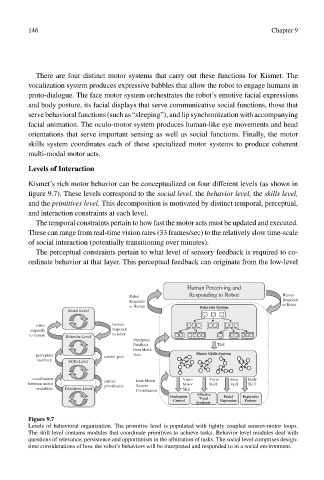
                       Kismet’s rich motor behavior can be conceptualized on four different levels (as shown in
                       figure 9.7). These levels correspond to the social level, the behavior level, the skills level,
                       and the primitives level. This decomposition is motivated by distinct temporal, perceptual,
                       and interaction constraints at each level.
                         The temporal constraints pertain to how fast the motor acts must be updated and executed.
                       These can range from real-time vision rates (33 frames/sec) to the relatively slow time-scale
                       of social interaction (potentially transitioning over minutes).
                         The perceptual constraints pertain to what level of sensory feedback is required to co-
                       ordinate behavior at that layer. This perceptual feedback can originate from the low-level


                                                                 Human Perceiving and
                                                  Robot           Responding to Robot      Human
                                                                                           Responds
                                                  Responds
                                                  to Human           Behavior System       to Robot
                                  Social Level
                         robot               human
                       responds              responds
                       to human  Behavior Level  to robot
                                                   Perceptual
                                                   Feedback              Task
                                                   from Motor
                         perceptual        current goal  Acts       Motor Skills System
                         feedback  Skills Level
                        coordination                            Visuo-  Vocal  Face  Body
                                           current  Inter-Motor
                       between motor       primitive(s)  System  Motor  Skill  Skill  Skill
                         modalities  Primitives Level           Skill
                                                    Coordination
                                                                    Affective
                                                             Oculomotor  Vocal  Facial  Expressive
                                                             Control      Expression  Posture
                                                                    Synthesis
                       Figure 9.7
                       Levels of behavioral organization. The primitive level is populated with tightly coupled sensori-motor loops.
                       The skill level contains modules that coordinate primitives to achieve tasks. Behavior level modules deal with
                       questions of relevance, persistence and opportunism in the arbitration of tasks. The social level comprises design-
                       time considerations of how the robot’s behaviors will be interpreted and responded to in a social environment.

