


Page 170 - Designing Sociable Robots
P. 170
breazeal-79017  book  March 18, 2002  14:7


                       The Behavior System                                                  151


                                           Avoidance Behavior
                         2000
                       Activation Level  1000 0  Stimulation Drive


                        –1000
                                 Engage Toy Behavior
                                 Avoid Toy Behavior
                        –2000    Seek Toy Behavior
                           0   5   10   15  20   25  30   35  40   45  50
                                              Time (seconds)
                         2000
                       Activation Level  0  Interest
                         1000

                        –1000
                                  Displeasure
                                  Fear
                        –2000     Sadness
                           0   5   10   15  20   25  30   35  40   45  50
                                              Time (seconds)
                         1
                        Position (% of Total Range)  0.5 0


                         0.5
                                              Eye Pan
                                              Eye Tilt
                                              Neck Pan
                         1
                          0    5   10  15   20  25   30  35   40   45  50
                                              Time (seconds)
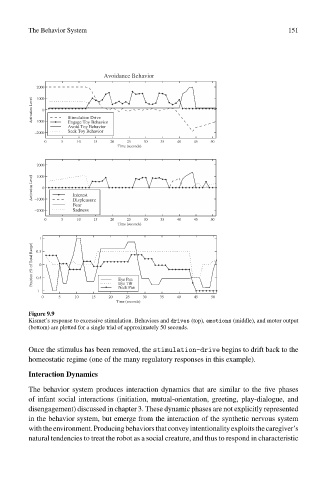
                       Figure 9.9
                       Kismet’s response to excessive stimulation. Behaviors and drives (top), emotions (middle), and motor output
                       (bottom) are plotted for a single trial of approximately 50 seconds.
                       Once the stimulus has been removed, the stimulation-drive begins to drift back to the
                       homeostatic regime (one of the many regulatory responses in this example).

                       Interaction Dynamics
                       The behavior system produces interaction dynamics that are similar to the five phases
                       of infant social interactions (initiation, mutual-orientation, greeting, play-dialogue, and
                       disengagement) discussed in chapter 3. These dynamic phases are not explicitly represented
                       in the behavior system, but emerge from the interaction of the synthetic nervous system
                       withtheenvironment.Producingbehaviorsthatconveyintentionalityexploitsthecaregiver’s
                       natural tendencies to treat the robot as a social creature, and thus to respond in characteristic

