


Page 168 - Designing Sociable Robots
P. 168
breazeal-79017  book  March 18, 2002  14:7


                       The Behavior System                                                  149


                       primitives is called a skill, and each skill is implemented as a finite state machine (FSM).
                       Each motor skill encodes knowledge of how to move from one motor state to the next,
                       where each sequence is designed to bring the robot closer to the current goal. The motor
                       skills level must arbitrate among the many different FSMs, selecting the one to become
                       active based on the active goal. This decision process is straightforward since there is an
                       FSM tailored for each task of the behavior system.
                         Many skills can be thought of as fixed action patterns (FAPs) as conceptualized by
                       early ethologists (Tinbergen, 1951; Lorenz, 1973). Each FAP consists of two components,
                       the action component and the taxis (or orienting) component. For Kismet, FAPs often
                       correspond to communicative gestures where the action component corresponds to the
                       facial gesture, and the taxis component (to whom the gesture is directed) is controlled by
                       gaze. People seem to intuitively understand that when Kismet makes eye contact with them,
                       they are the locus of Kismet’s attention and the robot’s behavior is organized about them.
                       This places the person in a state of action readiness where they are poised to respond to
                       Kismet’s gestures.
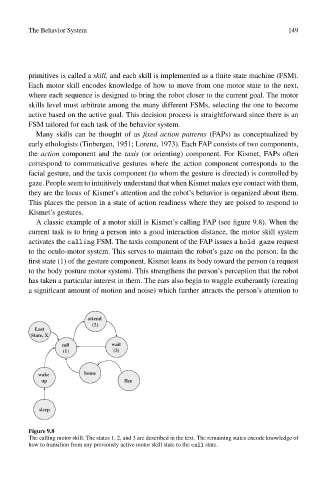
                         A classic example of a motor skill is Kismet’s calling FAP (see figure 9.8). When the
                       current task is to bring a person into a good interaction distance, the motor skill system
                       activates the calling FSM. The taxis component of the FAP issues a hold gaze request
                       to the oculo-motor system. This serves to maintain the robot’s gaze on the person. In the
                       first state (1) of the gesture component, Kismet leans its body toward the person (a request
                       to the body posture motor system). This strengthens the person’s perception that the robot
                       has taken a particular interest in them. The ears also begin to waggle exuberantly (creating
                       a significant amount of motion and noise) which further attracts the person’s attention to


                                      attend
                                        (2)
                        Last
                       State, X
                               call          wait
                                (1)          (3)


                         wake        home
                          up                    flee


                         sleep

                       Figure 9.8
                       The calling motor skill. The states 1, 2, and 3 are described in the text. The remaining states encode knowledge of
                       how to transition from any previously active motor skill state to the call state.

