


Page 171 - Designing Sociable Robots
P. 171
breazeal-79017  book  March 18, 2002  14:7


                       152                                                              Chapter 9


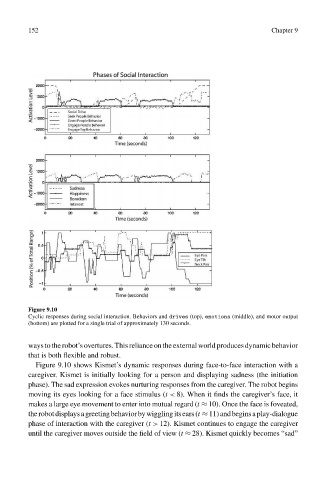
                       Figure 9.10
                       Cyclic responses during social interaction. Behaviors and drives (top), emotions (middle), and motor output
                       (bottom) are plotted for a single trial of approximately 130 seconds.


                       ways to the robot’s overtures. This reliance on the external world produces dynamic behavior
                       that is both flexible and robust.
                         Figure 9.10 shows Kismet’s dynamic responses during face-to-face interaction with a
                       caregiver. Kismet is initially looking for a person and displaying sadness (the initiation
                       phase). The sad expression evokes nurturing responses from the caregiver. The robot begins
                       moving its eyes looking for a face stimulus (t < 8). When it finds the caregiver’s face, it
                       makes a large eye movement to enter into mutual regard (t ≈ 10). Once the face is foveated,
                       therobotdisplaysagreetingbehaviorbywigglingitsears(t ≈ 11)andbeginsaplay-dialogue
                       phase of interaction with the caregiver (t > 12). Kismet continues to engage the caregiver
                       until the caregiver moves outside the field of view (t ≈ 28). Kismet quickly becomes “sad”

