


Page 160 - Designing Sociable Robots
P. 160
breazeal-79017  book  March 18, 2002  14:7


                       The Behavior System                                                  141


                                                 Social
                                                 Drive


                                          People  Satiate
                                         Present  Social


                                          Social Regulation BG   Boredom  Sorrow


                        Intense
                        or Bad                               No
                        Stimulus           Good             People
                                Avoid             Engage             Seek
                         Non-   Stimulus   People  People            People
                        Intense                             Found
                         Stim                               People
                                                                     [A, V, S]
                                                                   Search
                               Avoidance         Engagement
                                                                 Motor Skill
                               Strategies        Strategies
                                                                  Request
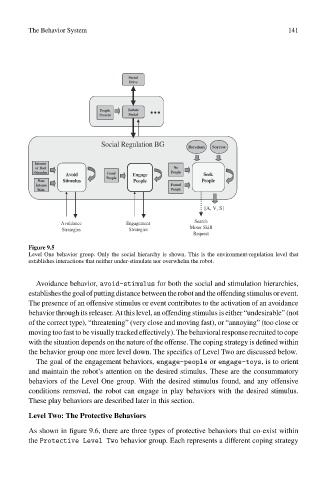
                       Figure 9.5
                       Level One behavior group. Only the social hierarchy is shown. This is the environment-regulation level that
                       establishes interactions that neither under-stimulate nor overwhelm the robot.


                         Avoidance behavior, avoid-stimulus for both the social and stimulation hierarchies,
                       establishesthegoalofputtingdistancebetweentherobotandtheoffendingstimulusorevent.
                       The presence of an offensive stimulus or event contributes to the activation of an avoidance
                       behavior through its releaser. At this level, an offending stimulus is either “undesirable” (not
                       of the correct type), “threatening” (very close and moving fast), or “annoying” (too close or
                       moving too fast to be visually tracked effectively). The behavioral response recruited to cope
                       with the situation depends on the nature of the offense. The coping strategy is defined within
                       the behavior group one more level down. The specifics of Level Two are discussed below.
                         The goal of the engagement behaviors, engage-people or engage-toys, is to orient
                       and maintain the robot’s attention on the desired stimulus. These are the consummatory
                       behaviors of the Level One group. With the desired stimulus found, and any offensive
                       conditions removed, the robot can engage in play behaviors with the desired stimulus.
                       These play behaviors are described later in this section.

                       Level Two: The Protective Behaviors
                       As shown in figure 9.6, there are three types of protective behaviors that co-exist within
                       the Protective Level Two behavior group. Each represents a different coping strategy

