


Page 181 - Designing Sociable Robots
P. 181
breazeal-79017  book  March 18, 2002  14:11


                       162                                                             Chapter 10


                       emphasis. Each subsystem serves a different facial function. The emotive facial expression
                       subsystem is responsible for generating expressions that convey the robot’s current moti-
                       vational state. Recall that the control of facial displays and behavior was partially covered
                       in chapter 9.
                         The lip synchronization and facial emphasis system is responsible for coordinating lips,
                       jaw,andtherestofthefacewithspeech.Thelipsaresynchronizedwiththespokenphonemes
                       as the rest of the face lends coordinated emphasis. See chapter 11 for the details of how
                       Kismet’s lip synchronization and facial emphasis system is implemented.
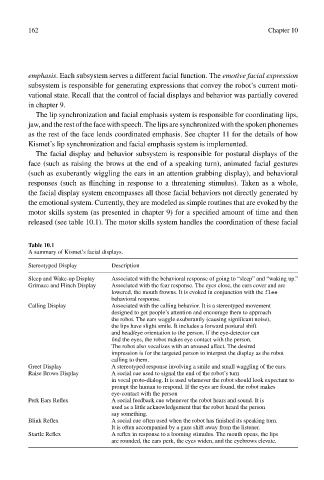
                         The facial display and behavior subsystem is responsible for postural displays of the
                       face (such as raising the brows at the end of a speaking turn), animated facial gestures
                       (such as exuberantly wiggling the ears in an attention grabbing display), and behavioral
                       responses (such as flinching in response to a threatening stimulus). Taken as a whole,
                       the facial display system encompasses all those facial behaviors not directly generated by
                       the emotional system. Currently, they are modeled as simple routines that are evoked by the
                       motor skills system (as presented in chapter 9) for a specified amount of time and then
                       released (see table 10.1). The motor skills system handles the coordination of these facial


                       Table 10.1
                       A summary of Kismet’s facial displays.

                       Stereotyped Display   Description
                       Sleep and Wake-up Display  Associated with the behavioral response of going to “sleep” and “waking up.”
                       Grimace and Flinch Display  Associated with the fear response. The eyes close, the ears cover and are
                                             lowered, the mouth frowns. It is evoked in conjunction with the flee
                                             behavioral response.
                       Calling Display       Associated with the calling behavior. It is a stereotyped movement
                                             designed to get people’s attention and encourage them to approach
                                             the robot. The ears waggle exuberantly (causing significant noise),
                                             the lips have slight smile. It includes a forward postural shift
                                             and head/eye orientation to the person. If the eye-detector can
                                             find the eyes, the robot makes eye contact with the person.
                                             The robot also vocalizes with an aroused affect. The desired
                                             impression is for the targeted person to interpret the display as the robot
                                             calling to them.
                       Greet Display         A stereotyped response involving a smile and small waggling of the ears.
                       Raise Brows Display   A social cue used to signal the end of the robot’s turn
                                             in vocal proto-dialog. It is used whenever the robot should look expectant to
                                             prompt the human to respond. If the eyes are found, the robot makes
                                             eye-contact with the person
                       Perk Ears Reflex       A social feedback cue whenever the robot hears and sound. It is
                                             used as a little acknowledgement that the robot heard the person
                                             say something.
                       Blink Reflex           A social cue often used when the robot has finished its speaking turn.
                                             It is often accompanied by a gaze shift away from the listener.
                       Startle Reflex         A reflex in response to a looming stimulus. The mouth opens, the lips
                                             are rounded, the ears perk, the eyes widen, and the eyebrows elevate.

