


Page 184 - Designing Sociable Robots
P. 184
breazeal-79017  book  March 18, 2002  14:11


                       Facial Animation and Expression                                      165


                                         Open
                                         stance

                                             accepting
                                                       Low
                        Negative                      arousal
                         valence       sorrow
                               unhappy
                       anger                      tired
                                                  soothed
                                   alert  calm
                                                 content   Positive
                                                           valence
                        fear                  joy
                              surprise
                        High         disgust
                       arousal
                                             stern
                                        Closed
                                         stance
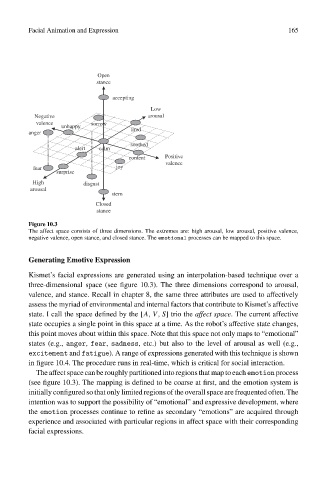
                       Figure 10.3
                       The affect space consists of three dimensions. The extremes are: high arousal, low arousal, positive valence,
                       negative valence, open stance, and closed stance. The emotional processes can be mapped to this space.


                       Generating Emotive Expression
                       Kismet’s facial expressions are generated using an interpolation-based technique over a
                       three-dimensional space (see figure 10.3). The three dimensions correspond to arousal,
                       valence, and stance. Recall in chapter 8, the same three attributes are used to affectively
                       assess the myriad of environmental and internal factors that contribute to Kismet’s affective
                       state. I call the space defined by the [A, V, S] trio the affect space. The current affective
                       state occupies a single point in this space at a time. As the robot’s affective state changes,
                       this point moves about within this space. Note that this space not only maps to “emotional”
                       states (e.g., anger, fear, sadness, etc.) but also to the level of arousal as well (e.g.,
                       excitement and fatigue). A range of expressions generated with this technique is shown
                       in figure 10.4. The procedure runs in real-time, which is critical for social interaction.
                         The affect space can be roughly partitioned into regions that map to each emotion process
                       (see figure 10.3). The mapping is defined to be coarse at first, and the emotion system is
                       initially configured so that only limited regions of the overall space are frequented often. The
                       intention was to support the possibility of “emotional” and expressive development, where
                       the emotion processes continue to refine as secondary “emotions” are acquired through
                       experience and associated with particular regions in affect space with their corresponding
                       facial expressions.

