


Page 187 - Designing Sociable Robots
P. 187
breazeal-79017  book  March 18, 2002  14:11


                       168                                                             Chapter 10


                                                      Open stance
                                                                              Low
                                   fear                                       arousal

                                                      accepting
                       Negative
                       valence
                                                                           tired

                           unhappy


                                                                         content
                            surprise

                                                                               Positive
                                                                               valence
                                            disgust

                                                            stern
                         High
                         arousal
                                   anger              Closed stance
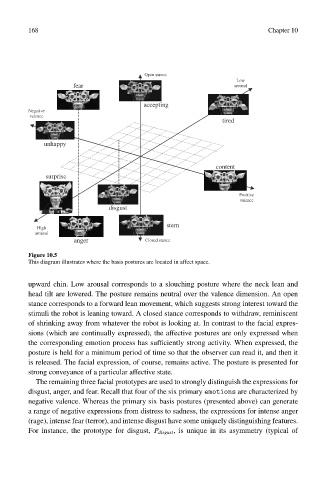
                       Figure 10.5
                       This diagram illustrates where the basis postures are located in affect space.


                       upward chin. Low arousal corresponds to a slouching posture where the neck lean and
                       head tilt are lowered. The posture remains neutral over the valence dimension. An open
                       stance corresponds to a forward lean movement, which suggests strong interest toward the
                       stimuli the robot is leaning toward. A closed stance corresponds to withdraw, reminiscent
                       of shrinking away from whatever the robot is looking at. In contrast to the facial expres-
                       sions (which are continually expressed), the affective postures are only expressed when
                       the corresponding emotion process has sufficiently strong activity. When expressed, the
                       posture is held for a minimum period of time so that the observer can read it, and then it
                       is released. The facial expression, of course, remains active. The posture is presented for
                       strong conveyance of a particular affective state.
                         The remaining three facial prototypes are used to strongly distinguish the expressions for
                       disgust, anger, and fear. Recall that four of the six primary emotions are characterized by
                       negative valence. Whereas the primary six basis postures (presented above) can generate
                       a range of negative expressions from distress to sadness, the expressions for intense anger
                       (rage), intense fear (terror), and intense disgust have some uniquely distinguishing features.
                       For instance, the prototype for disgust, P disgust , is unique in its asymmetry (typical of

