


Page 192 - Designing Sociable Robots
P. 192
breazeal-79017  book  March 18, 2002  14:11


                       Facial Animation and Expression                                      173


                       10.4  Analysis of Facial Expressions

                       Ekman and Friesen (1982) developed a commonly used facial measurement system called
                       FACS. The system measures the face itself as opposed to trying to infer the underlying
                       emotion given a particular facial configuration. This is a comprehensive system that distin-
                       guishes all possible visually distinguishable facial movements. Every such facial movement
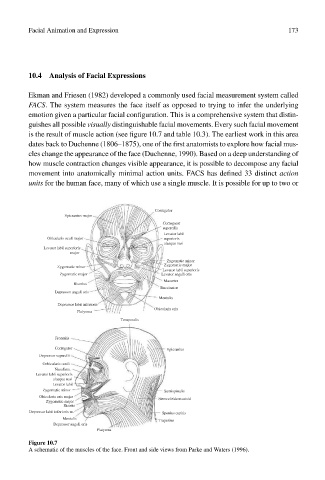
                       is the result of muscle action (see figure 10.7 and table 10.3). The earliest work in this area
                       dates back to Duchenne (1806–1875), one of the first anatomists to explore how facial mus-
                       cles change the appearance of the face (Duchenne, 1990). Based on a deep understanding of
                       how muscle contraction changes visible appearance, it is possible to decompose any facial
                       movement into anatomically minimal action units. FACS has defined 33 distinct action
                       units for the human face, many of which use a single muscle. It is possible for up to two or


                                                        Corrugator
                                Epicranius major
                                                          Corrugator
                                                          supercilli
                                                           Levator labii
                            Obicularis oculi major         superioris
                                                           alaeque nasi
                           Levator labii superioris
                                  major
                                                           Zygomatic minor
                                                           Zygomatic major
                              Zygomatic minor
                                                          Levator labii superioris
                               Zygomatic major            Levator anguli oris
                                                          Masseter
                                   Risorius
                                                          Buccinator
                              Depressor anguli oris
                                                         Mentalis
                              Depressor labii inferioris
                                                        Obicularis oris
                                   Platysma
                                               Temporalis
                              Frontalis
                              Corrugator                   Epicranius
                         Depressor superclii
                          Orbicularis oculi
                              Nasalism.
                        Levator labii superioris
                             alaeque nasi
                             Levator labii
                          Zygomatic minor                  Semispinalis
                         Obicularis oris major           Stemocleidomastoid
                           Zygomatic major
                                Risoris
                       Depressor labii inferioris m.      Spenius capitis
                                Mentalis
                                                         Trapezius
                             Depressor anguli oris
                                         Platysma
                       Figure 10.7
                       A schematic of the muscles of the face. Front and side views from Parke and Waters (1996).

