


Page 193 - Designing Sociable Robots
P. 193
breazeal-79017  book  March 18, 2002  14:11


                       174                                                             Chapter 10


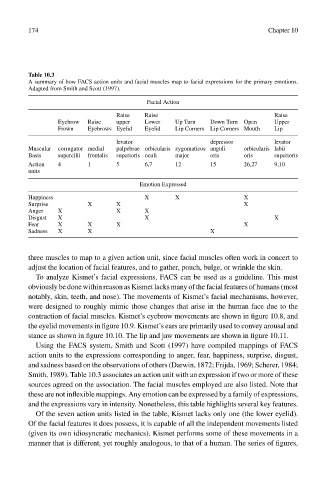
                       Table 10.3
                       A summary of how FACS action units and facial muscles map to facial expressions for the primary emotions.
                       Adapted from Smith and Scott (1997).

                                                       Facial Action
                                              Raise   Raise                             Raise
                               Eyebrow  Raise  upper  Lower   Up Turn  Down Turn  Open  Upper
                               Frown   Eyebrows Eyelid  Eyelid  Lip Corners  Lip Corners Mouth  Lip
                                              levator                  depressor        levator
                       Muscular  corrugator medial  palpebrae orbicularis zygomaticus anguli  orbicularis labii
                       Basis   supercilii  frontalis  superioris oculi  major  oris  oris  superioris
                       Action  4       1      5       6,7     12       15       26,27   9,10
                       units
                                                     Emotion Expressed
                       Happiness                      X       X                 X
                       Surprise        X      X                                 X
                       Anger   X              X       X
                       Disgust  X                     X                                 X
                       Fear    X       X      X                                 X
                       Sadness  X      X                               X


                       three muscles to map to a given action unit, since facial muscles often work in concert to
                       adjust the location of facial features, and to gather, pouch, bulge, or wrinkle the skin.
                         To analyze Kismet’s facial expressions, FACS can be used as a guideline. This must
                       obviously be done within reason as Kismet lacks many of the facial features of humans (most
                       notably, skin, teeth, and nose). The movements of Kismet’s facial mechanisms, however,
                       were designed to roughly mimic those changes that arise in the human face due to the
                       contraction of facial muscles. Kismet’s eyebrow movements are shown in figure 10.8, and
                       the eyelid movements in figure 10.9. Kismet’s ears are primarily used to convey arousal and
                       stance as shown in figure 10.10. The lip and jaw movements are shown in figure 10.11.
                         Using the FACS system, Smith and Scott (1997) have compiled mappings of FACS
                       action units to the expressions corresponding to anger, fear, happiness, surprise, disgust,
                       and sadness based on the observations of others (Darwin, 1872; Frijda, 1969; Scherer, 1984;
                       Smith, 1989). Table 10.3 associates an action unit with an expression if two or more of these
                       sources agreed on the association. The facial muscles employed are also listed. Note that
                       these are not inflexible mappings. Any emotion can be expressed by a family of expressions,
                       and the expressions vary in intensity. Nonetheless, this table highlights several key features.
                         Of the seven action units listed in the table, Kismet lacks only one (the lower eyelid).
                       Of the facial features it does possess, it is capable of all the independent movements listed
                       (given its own idiosyncratic mechanics). Kismet performs some of these movements in a
                       manner that is different, yet roughly analogous, to that of a human. The series of figures,

