


Page 194 - Designing Sociable Robots
P. 194
breazeal-79017  book  March 18, 2002  14:11


                       Facial Animation and Expression                                      175


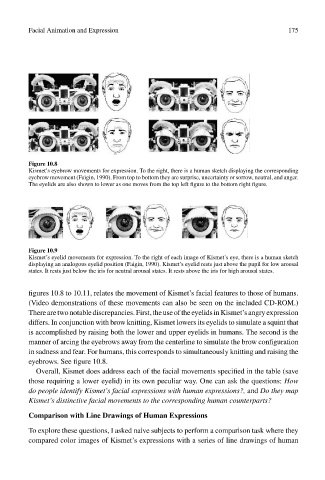
                       Figure 10.8
                       Kismet’s eyebrow movements for expression. To the right, there is a human sketch displaying the corresponding
                       eyebrow movement (Faigin, 1990). From top to bottom they are surprise, uncertainty or sorrow, neutral, and anger.
                       The eyelids are also shown to lower as one moves from the top left figure to the bottom right figure.


                       Figure 10.9
                       Kismet’s eyelid movements for expression. To the right of each image of Kismet’s eye, there is a human sketch
                       displaying an analogous eyelid position (Faigin, 1990). Kismet’s eyelid rests just above the pupil for low arousal
                       states. It rests just below the iris for neutral arousal states. It rests above the iris for high arousal states.

                       figures 10.8 to 10.11, relates the movement of Kismet’s facial features to those of humans.
                       (Video demonstrations of these movements can also be seen on the included CD-ROM.)
                       Therearetwonotablediscrepancies.First,theuseoftheeyelidsinKismet’sangryexpression
                       differs. In conjunction with brow knitting, Kismet lowers its eyelids to simulate a squint that
                       is accomplished by raising both the lower and upper eyelids in humans. The second is the
                       manner of arcing the eyebrows away from the centerline to simulate the brow configuration
                       in sadness and fear. For humans, this corresponds to simultaneously knitting and raising the
                       eyebrows. See figure 10.8.
                         Overall, Kismet does address each of the facial movements specified in the table (save
                       those requiring a lower eyelid) in its own peculiar way. One can ask the questions: How
                       do people identify Kismet’s facial expressions with human expressions?, and Do they map
                       Kismet’s distinctive facial movements to the corresponding human counterparts?
                       Comparison with Line Drawings of Human Expressions

                       To explore these questions, I asked naive subjects to perform a comparison task where they
                       compared color images of Kismet’s expressions with a series of line drawings of human

