


Page 199 - Designing Sociable Robots
P. 199
breazeal-79017  book  March 18, 2002  14:11


                       180                                                             Chapter 10


                       10.5  Evaluation of Expressive Behavior

                       The line drawing study did not ask the subjects what they thought the robot was expressing.
                       Clearly, however, this is an important question for my purposes. To explore this issue, a
                       separate questionnaire was devised. Given the wide variation in language that people use
                       to describe expressions and the small number of subjects, a forced choice paradigm was
                       adopted.
                         Seventeensubjectsfilledoutthequestionnaire.Mostofthesubjectswerechildren12years
                       of age (note that Kolb et al. [1992] found that the ability to recognize expressions continues
                       to develop, reaching adult level competence at approximately 14 years of age). There were
                       six girls, six boys, three adult men, and two adult women. Again, none of the adults had
                       seen the robot before. Some of the children reported minimal familiarity through reading
                       a children’s magazine article. There were seven pages in the questionnaire. Each page had
                       a large color image of Kismet displaying one of seven expressions (anger, disgust, fear,
                       happiness, sorrow, surprise, and a stern expression). The subjects could choose the best
                       match from ten possible labels (accepting, anger, bored, disgust, fear, joy, interest, sorrow,
                       stern, surprise). In a follow-up question, they could circle any other labels that they thought
                       could also apply. With respect to their best-choice answer, they were asked to specify on
                       a ten-point scale how confident they were of their answer, and how intense they found the
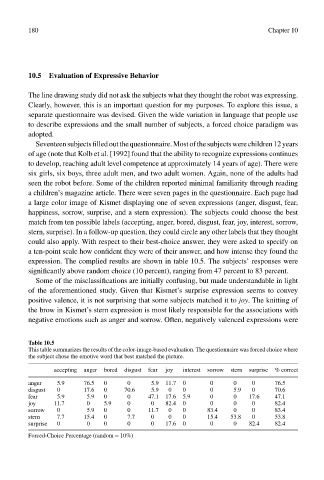
                       expression. The complied results are shown in table 10.5. The subjects’ responses were
                       significantly above random choice (10 percent), ranging from 47 percent to 83 percent.
                         Some of the misclassifications are initially confusing, but made understandable in light
                       of the aforementioned study. Given that Kismet’s surprise expression seems to convey
                       positive valence, it is not surprising that some subjects matched it to joy. The knitting of
                       the brow in Kismet’s stern expression is most likely responsible for the associations with
                       negative emotions such as anger and sorrow. Often, negatively valenced expressions were


                       Table 10.5
                       This table summarizes the results of the color-image-based evaluation. The questionnaire was forced choice where
                       the subject chose the emotive word that best matched the picture.
                              accepting  anger  bored  disgust  fear  joy  interest  sorrow  stern  surprise  % correct
                       anger   5.9    76.5  0    0      5.9  11.7  0   0      0   0      76.5
                       disgust  0     17.6  0    70.6   5.9  0  0      0      5.9  0     70.6
                       fear    5.9     5.9  0    0     47.1  17.6  5.9  0     0   17.6   47.1
                       joy    11.7     0   5.9   0      0  82.4  0     0      0   0      82.4
                       sorrow  0       5.9  0    0     11.7  0  0      83.4   0   0      83.4
                       stern   7.7    15.4  0    7.7    0   0   0      15.4  53.8  0     53.8
                       surprise  0     0   0     0      0  17.6  0     0      0   82.4   82.4
                       Forced-Choice Percentage (random = 10%)

