


Page 197 - Designing Sociable Robots
P. 197
breazeal-79017  book  March 18, 2002  14:11


                       178                                                             Chapter 10


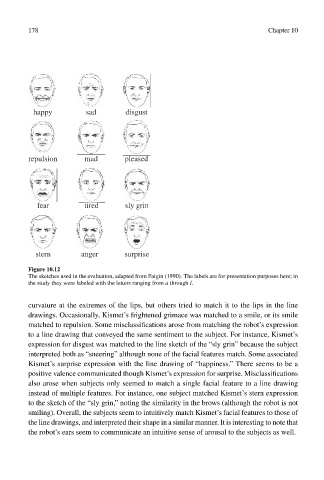
                        happy         sad        disgust


                       repulsion      mad        pleased


                         fear         tired      sly grin


                         stern       anger       surprise
                       Figure 10.12
                       The sketches used in the evaluation, adapted from Faigin (1990). The labels are for presentation purposes here; in
                       the study they were labeled with the letters ranging from a through l.

                       curvature at the extremes of the lips, but others tried to match it to the lips in the line
                       drawings. Occasionally, Kismet’s frightened grimace was matched to a smile, or its smile
                       matched to repulsion. Some misclassifications arose from matching the robot’s expression
                       to a line drawing that conveyed the same sentiment to the subject. For instance, Kismet’s
                       expression for disgust was matched to the line sketch of the “sly grin” because the subject
                       interpreted both as “sneering” although none of the facial features match. Some associated
                       Kismet’s surprise expression with the line drawing of “happiness.” There seems to be a
                       positive valence communicated though Kismet’s expression for surprise. Misclassifications
                       also arose when subjects only seemed to match a single facial feature to a line drawing
                       instead of multiple features. For instance, one subject matched Kismet’s stern expression
                       to the sketch of the “sly grin,” noting the similarity in the brows (although the robot is not
                       smiling). Overall, the subjects seem to intuitively match Kismet’s facial features to those of
                       the line drawings, and interpreted their shape in a similar manner. It is interesting to note that
                       the robot’s ears seem to communicate an intuitive sense of arousal to the subjects as well.

