


Page 195 - Designing Sociable Robots
P. 195
breazeal-79017  book  March 18, 2002  14:11


                       176                                                             Chapter 10


                                       elevated


                           closed       neutral      open


                                       lowered

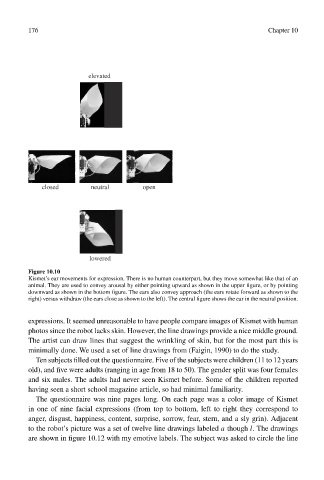
                       Figure 10.10
                       Kismet’s ear movements for expression. There is no human counterpart, but they move somewhat like that of an
                       animal. They are used to convey arousal by either pointing upward as shown in the upper figure, or by pointing
                       downward as shown in the bottom figure. The ears also convey approach (the ears rotate forward as shown to the
                       right) versus withdraw (the ears close as shown to the left). The central figure shows the ear in the neutral position.


                       expressions. It seemed unreasonable to have people compare images of Kismet with human
                       photos since the robot lacks skin. However, the line drawings provide a nice middle ground.
                       The artist can draw lines that suggest the wrinkling of skin, but for the most part this is
                       minimally done. We used a set of line drawings from (Faigin, 1990) to do the study.
                         Ten subjects filled out the questionnaire. Five of the subjects were children (11 to 12 years
                       old), and five were adults (ranging in age from 18 to 50). The gender split was four females
                       and six males. The adults had never seen Kismet before. Some of the children reported
                       having seen a short school magazine article, so had minimal familiarity.
                         The questionnaire was nine pages long. On each page was a color image of Kismet
                       in one of nine facial expressions (from top to bottom, left to right they correspond to
                       anger, disgust, happiness, content, surprise, sorrow, fear, stern, and a sly grin). Adjacent
                       to the robot’s picture was a set of twelve line drawings labeled a though l. The drawings
                       are shown in figure 10.12 with my emotive labels. The subject was asked to circle the line

