


Page 190 - Designing Sociable Robots
P. 190
breazeal-79017  book  March 18, 2002  14:11


                       Facial Animation and Expression                                      171


                                           arousal


                                            surprise

                                   afraid            elated

                                    stress         excitement

                         frustrated                           happy
                       displeasure                          pleasure
                             sad                          content
                                   depression  neutral
                                                   calm

                                   bored
                                                  relaxed


                                            sleepy
                                            sleep
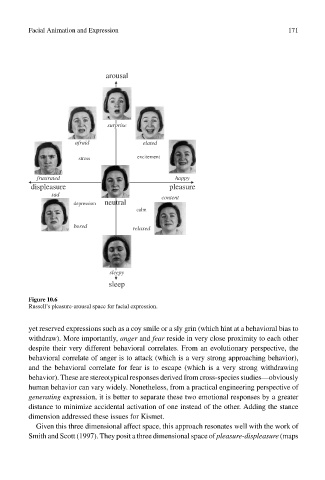
                       Figure 10.6
                       Russell’s pleasure-arousal space for facial expression.


                       yet reserved expressions such as a coy smile or a sly grin (which hint at a behavioral bias to
                       withdraw). More importantly, anger and fear reside in very close proximity to each other
                       despite their very different behavioral correlates. From an evolutionary perspective, the
                       behavioral correlate of anger is to attack (which is a very strong approaching behavior),
                       and the behavioral correlate for fear is to escape (which is a very strong withdrawing
                       behavior). These are stereotypical responses derived from cross-species studies—obviously
                       human behavior can vary widely. Nonetheless, from a practical engineering perspective of
                       generating expression, it is better to separate these two emotional responses by a greater
                       distance to minimize accidental activation of one instead of the other. Adding the stance
                       dimension addressed these issues for Kismet.
                         Given this three dimensional affect space, this approach resonates well with the work of
                       Smith and Scott (1997). They posit a three dimensional space of pleasure-displeasure (maps

