


Page 188 - Designing Sociable Robots
P. 188
breazeal-79017  book  March 18, 2002  14:11


                       Facial Animation and Expression                                      169


                       this expression). The prototypes for anger, P anger , and fear, P fear , each have a distinct
                       configuration for the lips (furious lips form a snarl, terrified lips form a grimace).
                         Each dimension of the affect space is bounded by the minimum and maximum allowable
                       values of (min, max) = (−1250, 1250). The placement of the prototype postures is given
                       in figure 10.5. The current net affective assessment from the emotion system defines the
                       [A, V, S] = (a,v, s)pointinaffectspace.Thespecific(a,v, s)valuesareusedtoweightthe
                       relative motor contributions of the basis postures. Using a weighted interpolation scheme,
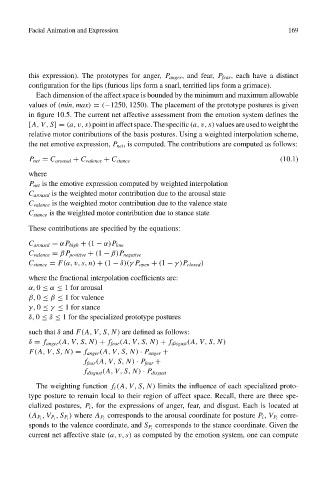
                       the net emotive expression, P net , is computed. The contributions are computed as follows:

                                                                                         (10.1)
                       P net = C arousal + C valence + C stance
                       where
                       P net is the emotive expression computed by weighted interpolation
                       C arousal is the weighted motor contribution due to the arousal state
                       C valence is the weighted motor contribution due to the valence state
                       C stance is the weighted motor contribution due to stance state
                       These contributions are specified by the equations:

                       C arousal = αP high + (1 − α)P low
                       C valence = β P positive + (1 − β)P negative
                       C stance = F(a,v, s, n) + (1 − δ)(γ P open + (1 − γ)P closed )

                       where the fractional interpolation coefficients are:
                       α, 0 ≤ α ≤ 1 for arousal
                       β, 0 ≤ β ≤ 1 for valence
                       γ, 0 ≤ γ ≤ 1 for stance
                       δ, 0 ≤ δ ≤ 1 for the specialized prototype postures

                       such that δ and F(A, V, S, N) are defined as follows:
                       δ = f anger (A, V, S, N) + f fear (A, V, S, N) + f disgust (A, V, S, N)
                       F(A, V, S, N) = f anger (A, V, S, N) · P anger +
                                     f fear (A, V, S, N) · P fear +
                                     f disgust (A, V, S, N) · P disgust
                         The weighting function f i (A, V, S, N) limits the influence of each specialized proto-
                       type posture to remain local to their region of affect space. Recall, there are three spe-
                       cialized postures, P i , for the expressions of anger, fear, and disgust. Each is located at
                                                                                          corre-
                       (A P i  , V P i  , S P i  ) where A P i  corresponds to the arousal coordinate for posture P i , V P i
                                                        corresponds to the stance coordinate. Given the
                       sponds to the valence coordinate, and S P i
                       current net affective state (a,v, s) as computed by the emotion system, one can compute

