


Page 191 - Designing Sociable Robots
P. 191
breazeal-79017  book  March 18, 2002  14:11


                       172                                                             Chapter 10


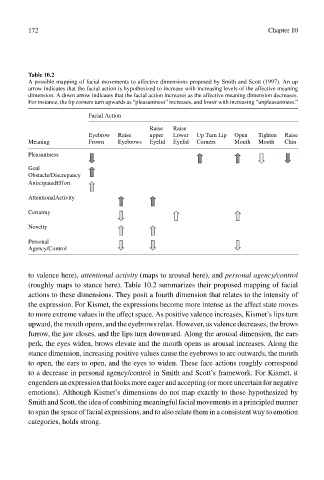
                       Table 10.2
                       A possible mapping of facial movements to affective dimensions proposed by Smith and Scott (1997). An up
                       arrow indicates that the facial action is hypothesized to increase with increasing levels of the affective meaning
                       dimension. A down arrow indicates that the facial action increases as the affective meaning dimension decreases.
                       For instance, the lip corners turn upwards as “pleasantness” increases, and lower with increasing “unpleasantness.”
                                       Facial Action
                                                       Raise  Raise
                                       Eyebrow  Raise  upper  Lower  Up Turn Lip  Open  Tighten  Raise
                       Meaning         Frown   Eyebrows  Eyelid  Eyelid  Corners  Mouth  Mouth  Chin
                       Pleasantness
                       Goal
                       Obstacle/Discrepancy
                       AnticipatedEffort
                       AttentionalActivity

                       Certainty
                       Novelty

                       Personal
                       Agency/Control


                       to valence here), attentional activity (maps to arousal here), and personal agency/control
                       (roughly maps to stance here). Table 10.2 summarizes their proposed mapping of facial
                       actions to these dimensions. They posit a fourth dimension that relates to the intensity of
                       the expression. For Kismet, the expressions become more intense as the affect state moves
                       to more extreme values in the affect space. As positive valence increases, Kismet’s lips turn
                       upward, the mouth opens, and the eyebrows relax. However, as valence decreases, the brows
                       furrow, the jaw closes, and the lips turn downward. Along the arousal dimension, the ears
                       perk, the eyes widen, brows elevate and the mouth opens as arousal increases. Along the
                       stance dimension, increasing positive values cause the eyebrows to arc outwards, the mouth
                       to open, the ears to open, and the eyes to widen. These face actions roughly correspond
                       to a decrease in personal agency/control in Smith and Scott’s framework. For Kismet, it
                       engenders an expression that looks more eager and accepting (or more uncertain for negative
                       emotions). Although Kismet’s dimensions do not map exactly to those hypothesized by
                       Smith and Scott, the idea of combining meaningful facial movements in a principled manner
                       to span the space of facial expressions, and to also relate them in a consistent way to emotion
                       categories, holds strong.

