


Page 196 - Designing Sociable Robots
P. 196
breazeal-79017  book  March 18, 2002  14:11


                       Facial Animation and Expression                                      177


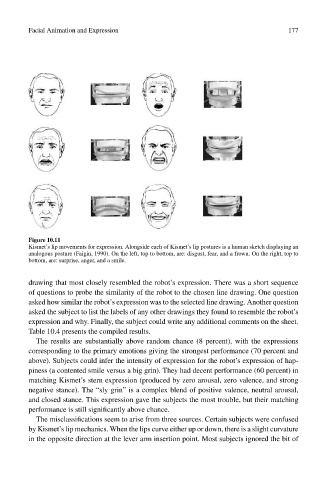
                       Figure 10.11
                       Kismet’s lip movements for expression. Alongside each of Kismet’s lip postures is a human sketch displaying an
                       analogous posture (Faigin, 1990). On the left, top to bottom, are: disgust, fear, and a frown. On the right, top to
                       bottom, are: surprise, anger, and a smile.

                       drawing that most closely resembled the robot’s expression. There was a short sequence
                       of questions to probe the similarity of the robot to the chosen line drawing. One question
                       asked how similar the robot’s expression was to the selected line drawing. Another question
                       asked the subject to list the labels of any other drawings they found to resemble the robot’s
                       expression and why. Finally, the subject could write any additional comments on the sheet.
                       Table 10.4 presents the compiled results.
                         The results are substantially above random chance (8 percent), with the expressions
                       corresponding to the primary emotions giving the strongest performance (70 percent and
                       above). Subjects could infer the intensity of expression for the robot’s expression of hap-
                       piness (a contented smile versus a big grin). They had decent performance (60 percent) in
                       matching Kismet’s stern expression (produced by zero arousal, zero valence, and strong
                       negative stance). The “sly grin” is a complex blend of positive valence, neutral arousal,
                       and closed stance. This expression gave the subjects the most trouble, but their matching
                       performance is still significantly above chance.
                         The misclassifications seem to arise from three sources. Certain subjects were confused
                       by Kismet’s lip mechanics. When the lips curve either up or down, there is a slight curvature
                       in the opposite direction at the lever arm insertion point. Most subjects ignored the bit of

