


Page 200 - Designing Sociable Robots
P. 200
breazeal-79017  book  March 18, 2002  14:11


                       Facial Animation and Expression                                      181


                       misclassified with negatively valenced labels. For instance, labeling the sad expression with
                       fear, or the disgust expression with anger or fear. Kismet’s expression for fear seems to give
                       people the most difficulty. The lip mechanics probably account for the association with joy.
                       The wide eyes, elevated brows, and elevated ears suggest high arousal. This may account
                       for the confusion with surprise.
                         The still image and line drawing studies were useful in understanding how people read
                       Kismet’s facial expressions, but it says very little about expressive posturing. Humans and
                       animals not only express with their face, but with their entire body. To explore this issue
                       for Kismet, I showed a small group of subjects a set of video clips.
                         There were seven people who filled out the questionnaire. Six were children of age 12,
                       four boys and two girls. One was an adult female. In each clip Kismet performs a coordinated
                       expression using face and body posture. There were seven videos in all (anger, disgust, fear,
                       joy, interest, sorrow, and surprise). Using a forced-choice paradigm, for each video the
                       subject was asked to select a word that best described the robot’s expression (anger, disgust,
                       fear, joy, interest, sorrow, or surprise). On a ten-point scale, the subjects were also asked
                       to rate the intensity of the robot’s expression and the certainty of their answer. They were
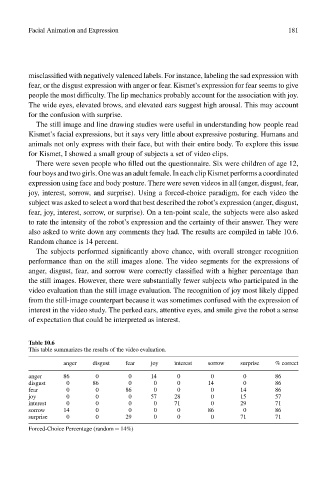
                       also asked to write down any comments they had. The results are compiled in table 10.6.
                       Random chance is 14 percent.
                         The subjects performed significantly above chance, with overall stronger recognition
                       performance than on the still images alone. The video segments for the expressions of
                       anger, disgust, fear, and sorrow were correctly classified with a higher percentage than
                       the still images. However, there were substantially fewer subjects who participated in the
                       video evaluation than the still image evaluation. The recognition of joy most likely dipped
                       from the still-image counterpart because it was sometimes confused with the expression of
                       interest in the video study. The perked ears, attentive eyes, and smile give the robot a sense
                       of expectation that could be interpreted as interest.


                       Table 10.6
                       This table summarizes the results of the video evaluation.
                                anger   disgust  fear  joy   interest  sorrow  surprise  % correct
                       anger    86      0        0     14     0        0        0       86
                       disgust   0      86       0      0     0       14        0       86
                       fear      0      0       86      0     0        0       14       86
                       joy       0      0        0     57    28        0       15       57
                       interest  0      0        0      0    71        0       29       71
                       sorrow   14      0        0      0     0       86        0       86
                       surprise  0      0       29      0     0        0       71       71
                       Forced-Choice Percentage (random = 14%)

