


Page 21 - Designing Sociable Robots
P. 21
breazeal-79017  book  March 18, 2002  13:50


                       2                                                                Chapter 1


                       efforts are under way to use robots in treatment of autistic children (Dautenhahn, 2000) and
                       to try to understand this impairment by modeling it on robots (Scassellati, 2000b).
                         As humans, we not only strive to understand ourselves, but we also turn to technology
                       to enhance the quality of our lives. From an engineering perspective, we try to make these
                       technologies natural and intuitive to use and to interact with. As our technologies become
                       more intelligent and more complex, we still want to interact with them in a familiar way. We
                       tend to anthropomorphize our computers, our cars, and other gadgets for this reason, and
                       their interfaces resemble how we interact with each other more and more (Mithen, 1996).
                       Perhaps this is not surprising given that our brains have evolved for us to be experts in social
                       interaction (Barton & Dunbar, 1997).
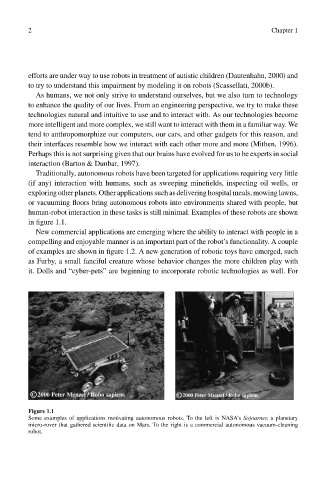
                         Traditionally, autonomous robots have been targeted for applications requiring very little
                       (if any) interaction with humans, such as sweeping minefields, inspecting oil wells, or
                       exploring other planets. Other applications such as delivering hospital meals, mowing lawns,
                       or vacuuming floors bring autonomous robots into environments shared with people, but
                       human-robot interaction in these tasks is still minimal. Examples of these robots are shown
                       in figure 1.1.
                         New commercial applications are emerging where the ability to interact with people in a
                       compelling and enjoyable manner is an important part of the robot’s functionality. A couple
                       of examples are shown in figure 1.2. A new generation of robotic toys have emerged, such
                       as Furby, a small fanciful creature whose behavior changes the more children play with
                       it. Dolls and “cyber-pets” are beginning to incorporate robotic technologies as well. For


                       Figure 1.1
                       Some examples of applications motivating autonomous robots. To the left is NASA’s Sojourner, a planetary
                       micro-rover that gathered scientific data on Mars. To the right is a commercial autonomous vacuum-cleaning
                       robot.

