


Page 25 - Designing Sociable Robots
P. 25
breazeal-79017  book  March 18, 2002  13:50


                       6                                                                Chapter 1


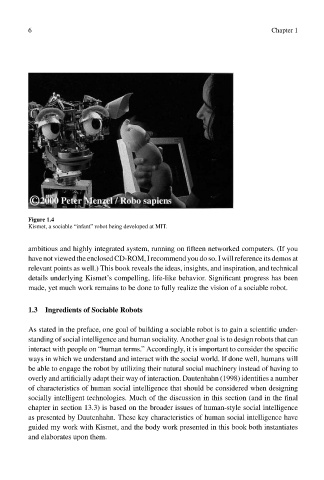
                       Figure 1.4
                       Kismet, a sociable “infant” robot being developed at MIT.


                       ambitious and highly integrated system, running on fifteen networked computers. (If you
                       have not viewed the enclosed CD-ROM, I recommend you do so. I will reference its demos at
                       relevant points as well.) This book reveals the ideas, insights, and inspiration, and technical
                       details underlying Kismet’s compelling, life-like behavior. Significant progress has been
                       made, yet much work remains to be done to fully realize the vision of a sociable robot.


                       1.3 Ingredients of Sociable Robots

                       As stated in the preface, one goal of building a sociable robot is to gain a scientific under-
                       standing of social intelligence and human sociality. Another goal is to design robots that can
                       interact with people on “human terms.” Accordingly, it is important to consider the specific
                       ways in which we understand and interact with the social world. If done well, humans will
                       be able to engage the robot by utilizing their natural social machinery instead of having to
                       overly and artificially adapt their way of interaction. Dautenhahn (1998) identifies a number
                       of characteristics of human social intelligence that should be considered when designing
                       socially intelligent technologies. Much of the discussion in this section (and in the final
                       chapter in section 13.3) is based on the broader issues of human-style social intelligence
                       as presented by Dautenhahn. These key characteristics of human social intelligence have
                       guided my work with Kismet, and the body work presented in this book both instantiates
                       and elaborates upon them.

