


Page 238 - Designing Sociable Robots
P. 238
breazeal-79017  book  March 18, 2002  14:20


                       Social Constraints on Animate Vision                                 219


                                   Wide                Wide     Left Foveal  Right Foveal
                                  Camera 1           Camera 2    Camera      Camera
                                   Wide               Wide 2      Left        Right
                                  Frame               Frame      Frame       Frame
                                  Grabber            Grabber     Grabber     Grabber

                        Skin   Color  Motion  Face    Distance    Eye         Foveal
                       Detector  Detector  Detector  Detector  to Target  Finder  Disparity
                                               tracked target
                            W    W    W   W            Wide
                                                Most salient  Tracker
                                 Attention       target
                        Behaviors                        locus of attention  disparity
                                     ballistic movement
                          &
                       Motivations
                                          ...
                               Fixed Action  θ p, θ p, θ p   Saccade  Smooth Pursuit
                                 Pattern      w/Neck  VOR              & Vergence
                                              Comp                     w/Neck Comp
                                Affective         ...             ...
                                 Postural  ...   θ s, θ s, θ s   θ v, θ v, θ v
                               Shifts w/Gaze               Arbitor
                                        θ f, θ f, θ f    ...
                                 Comp                  Θ , Θ , Θ  Eye-Head-Neck Control
                                                           Motor    Motors
                                                           Daemon
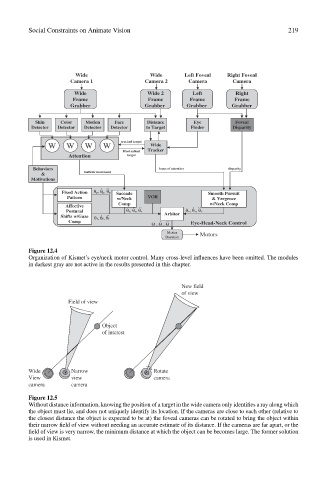
                       Figure 12.4
                       Organization of Kismet’s eye/neck motor control. Many cross-level influences have been omitted. The modules
                       in darkest gray are not active in the results presented in this chapter.
                                                               New field
                                                               of view
                                 Field of view


                                          Object
                                          of interest


                       Wide       Narrow                Rotate
                       View       view                  camera
                       camera     camera

                       Figure 12.5
                       Without distance information, knowing the position of a target in the wide camera only identifies a ray along which
                       the object must lie, and does not uniquely identify its location. If the cameras are close to each other (relative to
                       the closest distance the object is expected to be at) the foveal cameras can be rotated to bring the object within
                       their narrow field of view without needing an accurate estimate of its distance. If the cameras are far apart, or the
                       field of view is very narrow, the minimum distance at which the object can be becomes large. The former solution
                       is used in Kismet.

