


Page 241 - Designing Sociable Robots
P. 241
breazeal-79017  book  March 18, 2002  14:20


                       222                                                             Chapter 12


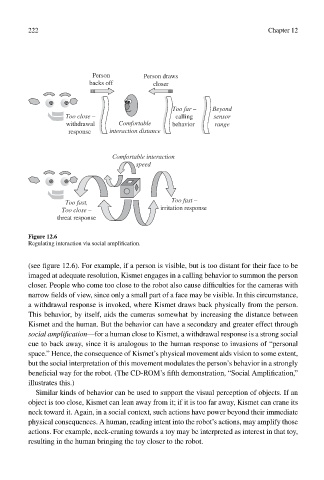
                                        Person        Person draws
                                       backs off        closer


                                                             Too far –  Beyond
                                 Too close –                  calling   sensor
                                 withdrawal    Comfortable   behavior    range
                                  response   interaction distance


                                             Comfortable interaction
                                                    speed


                                 Too fast,                   Too fast –
                                Too close –               irritation response
                               threat response

                       Figure 12.6
                       Regulating interaction via social amplification.


                       (see figure 12.6). For example, if a person is visible, but is too distant for their face to be
                       imaged at adequate resolution, Kismet engages in a calling behavior to summon the person
                       closer. People who come too close to the robot also cause difficulties for the cameras with
                       narrow fields of view, since only a small part of a face may be visible. In this circumstance,
                       a withdrawal response is invoked, where Kismet draws back physically from the person.
                       This behavior, by itself, aids the cameras somewhat by increasing the distance between
                       Kismet and the human. But the behavior can have a secondary and greater effect through
                       social amplification—for a human close to Kismet, a withdrawal response is a strong social
                       cue to back away, since it is analogous to the human response to invasions of “personal
                       space.” Hence, the consequence of Kismet’s physical movement aids vision to some extent,
                       but the social interpretation of this movement modulates the person’s behavior in a strongly
                       beneficial way for the robot. (The CD-ROM’s fifth demonstration, “Social Amplification,”
                       illustrates this.)
                         Similar kinds of behavior can be used to support the visual perception of objects. If an
                       object is too close, Kismet can lean away from it; if it is too far away, Kismet can crane its
                       neck toward it. Again, in a social context, such actions have power beyond their immediate
                       physical consequences. A human, reading intent into the robot’s actions, may amplify those
                       actions. For example, neck-craning towards a toy may be interpreted as interest in that toy,
                       resulting in the human bringing the toy closer to the robot.

