


Page 63 - Designing Sociable Robots
P. 63
breazeal-79017  book  March 18, 2002  13:59


                       44                                                               Chapter 4


                               Low-Level   High-Level Perception System
                       Sensors  Feature
                                            “People”    “Toys”
                               Extraction   Releasers  Stimulation
                                             Social
                           World & Caregiver  Attention  Behavior System  Motivation
                                                       Releasers

                                                                   System
                               System
                                                                   Drives


                                        Motor System
                                         Motor Skills
                                                                  Emotion
                           Motors                                  System
                                    Orient  Face Expr  Vocal
                                   Head &  & Body  Acts
                                    Eyes   Postures

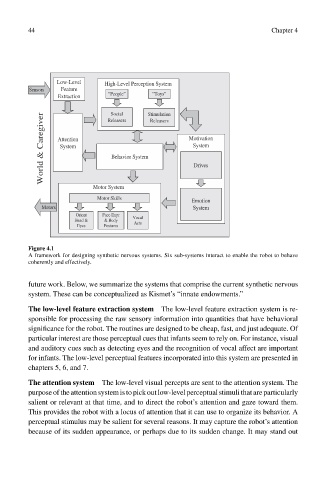
                       Figure 4.1
                       A framework for designing synthetic nervous systems. Six sub-systems interact to enable the robot to behave
                       coherently and effectively.


                       future work. Below, we summarize the systems that comprise the current synthetic nervous
                       system. These can be conceptualized as Kismet’s “innate endowments.”

                       The low-level feature extraction system  The low-level feature extraction system is re-
                       sponsible for processing the raw sensory information into quantities that have behavioral
                       significance for the robot. The routines are designed to be cheap, fast, and just adequate. Of
                       particular interest are those perceptual cues that infants seem to rely on. For instance, visual
                       and auditory cues such as detecting eyes and the recognition of vocal affect are important
                       for infants. The low-level perceptual features incorporated into this system are presented in
                       chapters 5, 6, and 7.
                       The attention system The low-level visual percepts are sent to the attention system. The
                       purposeoftheattentionsystemistopickoutlow-levelperceptualstimulithatareparticularly
                       salient or relevant at that time, and to direct the robot’s attention and gaze toward them.
                       This provides the robot with a locus of attention that it can use to organize its behavior. A
                       perceptual stimulus may be salient for several reasons. It may capture the robot’s attention
                       because of its sudden appearance, or perhaps due to its sudden change. It may stand out

