


Page 66 - Designing Sociable Robots
P. 66
breazeal-79017  book  March 18, 2002  13:59


                       Designing Sociable Robots                                             47


                                        bias


                       inputs  gains    node       output


                                      threshold, T

                                0                 Amax
                                       Activation level, A
                                     A= (Σ inputs * gains) + bias

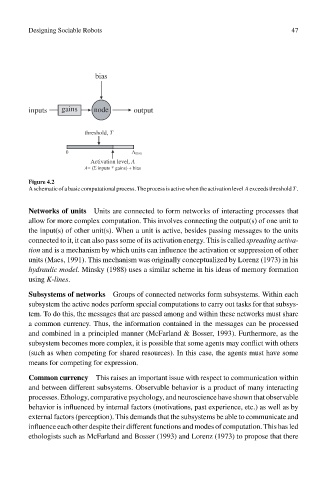
                       Figure 4.2
                       Aschematicofabasiccomputationalprocess.Theprocessisactivewhentheactivationlevel A exceedsthreshold T .


                       Networks of units Units are connected to form networks of interacting processes that
                       allow for more complex computation. This involves connecting the output(s) of one unit to
                       the input(s) of other unit(s). When a unit is active, besides passing messages to the units
                       connected to it, it can also pass some of its activation energy. This is called spreading activa-
                       tion and is a mechanism by which units can influence the activation or suppression of other
                       units (Maes, 1991). This mechanism was originally conceptualized by Lorenz (1973) in his
                       hydraulic model. Minsky (1988) uses a similar scheme in his ideas of memory formation
                       using K-lines.
                       Subsystems of networks Groups of connected networks form subsystems. Within each
                       subsystem the active nodes perform special computations to carry out tasks for that subsys-
                       tem. To do this, the messages that are passed among and within these networks must share
                       a common currency. Thus, the information contained in the messages can be processed
                       and combined in a principled manner (McFarland & Bosser, 1993). Furthermore, as the
                       subsystem becomes more complex, it is possible that some agents may conflict with others
                       (such as when competing for shared resources). In this case, the agents must have some
                       means for competing for expression.
                       Common currency This raises an important issue with respect to communication within
                       and between different subsystems. Observable behavior is a product of many interacting
                       processes. Ethology, comparative psychology, and neuroscience have shown that observable
                       behavior is influenced by internal factors (motivations, past experience, etc.) as well as by
                       external factors (perception). This demands that the subsystems be able to communicate and
                       influence each other despite their different functions and modes of computation. This has led
                       ethologists such as McFarland and Bosser (1993) and Lorenz (1973) to propose that there

