


Page 71 - Designing Sociable Robots
P. 71
breazeal-79017  book  March 18, 2002  14:1


                       52                                                               Chapter 5


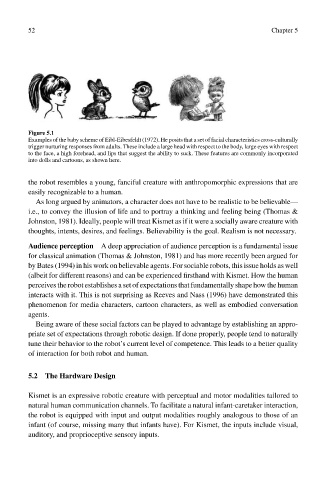
                       Figure 5.1
                       Examples of the baby scheme of Eibl-Eibesfeldt (1972). He posits that a set of facial characteristics cross-culturally
                       trigger nurturing responses from adults. These include a large head with respect to the body, large eyes with respect
                       to the face, a high forehead, and lips that suggest the ability to suck. These features are commonly incorporated
                       into dolls and cartoons, as shown here.


                       the robot resembles a young, fanciful creature with anthropomorphic expressions that are
                       easily recognizable to a human.
                         As long argued by animators, a character does not have to be realistic to be believable—
                       i.e., to convey the illusion of life and to portray a thinking and feeling being (Thomas &
                       Johnston, 1981). Ideally, people will treat Kismet as if it were a socially aware creature with
                       thoughts, intents, desires, and feelings. Believability is the goal. Realism is not necessary.
                       Audience perception  A deep appreciation of audience perception is a fundamental issue
                       for classical animation (Thomas & Johnston, 1981) and has more recently been argued for
                       by Bates (1994) in his work on believable agents. For sociable robots, this issue holds as well
                       (albeit for different reasons) and can be experienced firsthand with Kismet. How the human
                       perceives the robot establishes a set of expectations that fundamentally shape how the human
                       interacts with it. This is not surprising as Reeves and Nass (1996) have demonstrated this
                       phenomenon for media characters, cartoon characters, as well as embodied conversation
                       agents.
                         Being aware of these social factors can be played to advantage by establishing an appro-
                       priate set of expectations through robotic design. If done properly, people tend to naturally
                       tune their behavior to the robot’s current level of competence. This leads to a better quality
                       of interaction for both robot and human.


                       5.2  The Hardware Design

                       Kismet is an expressive robotic creature with perceptual and motor modalities tailored to
                       natural human communication channels. To facilitate a natural infant-caretaker interaction,
                       the robot is equipped with input and output modalities roughly analogous to those of an
                       infant (of course, missing many that infants have). For Kismet, the inputs include visual,
                       auditory, and proprioceptive sensory inputs.

