


Page 74 - Designing Sociable Robots
P. 74
breazeal-79017  book  March 18, 2002  14:1


                       The Physical Robot                                                    55


                         Kismet’s vision system is implemented on a network of nine 400 MHz commercial PCs
                       running the QNX real-time operating system. The PCs are connected together via 100 MB
                       Ethernet. There are frame grabbers and video distribution amplifiers to distribute multiple
                       copies of a given image with minimal latencies. The cameras that are used to compute stereo
                       measures are externally synchronized.
                       The Auditory System
                       The caregiver can influence the robot’s behavior through speech by wearing a small un-
                       obtrusive wireless microphone. This auditory signal is fed into a 500 MHz PC running
                       Linux. The real-time, low-level speech processing and recognition software was developed
                       at MIT by the Spoken Language Systems Group. These auditory features are sent to a dual
                       450 mHz PC running Windows NT. The NT machine processes these features in real-time
                       to recognize the spoken affective intent of the caregiver. The Linux and NT machines are
                       connected via 100 MB Ethernet to a shared hub and use CORBA for communication.

                       The Expressive Motor System
                       Kismet is able to display a wide assortment of facial expressions that mirror its affec-
                       tive state, as well as produce numerous facial displays for other communicative purposes
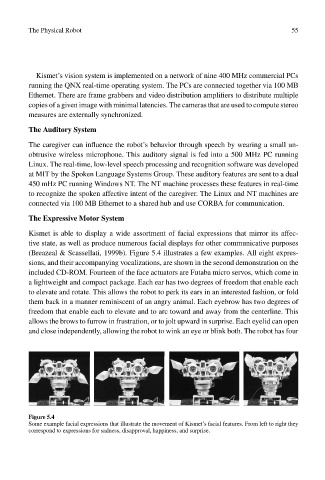
                       (Breazeal & Scassellati, 1999b). Figure 5.4 illustrates a few examples. All eight expres-
                       sions, and their accompanying vocalizations, are shown in the second demonstration on the
                       included CD-ROM. Fourteen of the face actuators are Futaba micro servos, which come in
                       a lightweight and compact package. Each ear has two degrees of freedom that enable each
                       to elevate and rotate. This allows the robot to perk its ears in an interested fashion, or fold
                       them back in a manner reminiscent of an angry animal. Each eyebrow has two degrees of
                       freedom that enable each to elevate and to arc toward and away from the centerline. This
                       allows the brows to furrow in frustration, or to jolt upward in surprise. Each eyelid can open
                       and close independently, allowing the robot to wink an eye or blink both. The robot has four


                       Figure 5.4
                       Some example facial expressions that illustrate the movement of Kismet’s facial features. From left to right they
                       correspond to expressions for sadness, disapproval, happiness, and surprise.

