


Page 77 - Designing Sociable Robots
P. 77
breazeal-79017  book  March 18, 2002  14:1


                       58                                                               Chapter 5


                       system as being broad and simple where the perceptual abilities are robust enough and
                       detailed enough for these early human-robot interactions. Deep and complicated percep-
                       tual algorithms certainly exist. As we have learned from human infants, however, there
                       are developmental advantages to starting out broad and simple and allowing the percep-
                       tual, behavioral, and motor systems to develop in step. Kismet’s initial perceptual system
                       specification is designed to be roughly analogous to a human infant. While human infants
                       certainly perceive more things than Kismet, it is quite a sophisticated perceptual system for
                       an autonomous robot.
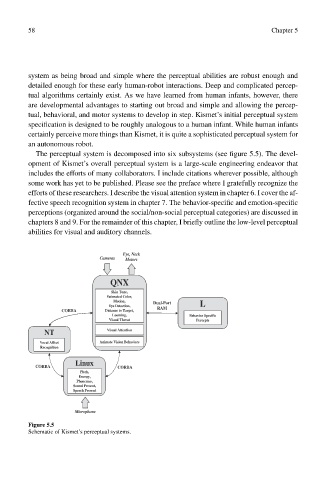
                         The perceptual system is decomposed into six subsystems (see figure 5.5). The devel-
                       opment of Kismet’s overall perceptual system is a large-scale engineering endeavor that
                       includes the efforts of many collaborators. I include citations wherever possible, although
                       some work has yet to be published. Please see the preface where I gratefully recognize the
                       efforts of these researchers. I describe the visual attention system in chapter 6. I cover the af-
                       fective speech recognition system in chapter 7. The behavior-specific and emotion-specific
                       perceptions (organized around the social/non-social perceptual categories) are discussed in
                       chapters 8 and 9. For the remainder of this chapter, I briefly outline the low-level perceptual
                       abilities for visual and auditory channels.


                                                Eye, Neck
                                          Cameras  Motors

                                             QNX
                                             Skin Tone,
                                            Saturated Color,
                                              Motion,   Dual-Port
                                            Eye Detection,  RAM      L
                                CORBA      Distance to Target,
                                             Looming,             Behavior Specific
                                            Visual Threat           Percepts
                           NT               Visual Attention
                          Vocal Affect    Animate Vision Behaviors
                          Recognition
                                   Linux
                         CORBA                 CORBA
                                     Pitch,
                                    Energy,
                                    Phonemes,
                                   Sound Present,
                                   Speech Present
                                   Microphone
                       Figure 5.5
                       Schematic of Kismet’s perceptual systems.

