


Page 81 - Designing Sociable Robots
P. 81
breazeal-79017  book  March 18, 2002  14:2


                       62                                                               Chapter 6


                                                Frame Grabber


                         Skin Tone          Color           Motion         Habituation


                            w                w                w                w


                                                                  inhibit  reset
                                                   Attention
                                Top Down,
                                Task-Driven                        Eye Motor
                                                                    Control
                                 Influences


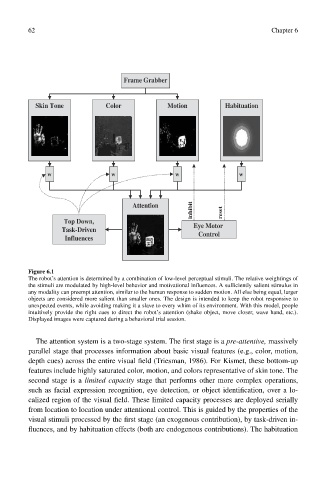
                       Figure 6.1
                       The robot’s attention is determined by a combination of low-level perceptual stimuli. The relative weightings of
                       the stimuli are modulated by high-level behavior and motivational influences. A sufficiently salient stimulus in
                       any modality can preempt attention, similar to the human response to sudden motion. All else being equal, larger
                       objects are considered more salient than smaller ones. The design is intended to keep the robot responsive to
                       unexpected events, while avoiding making it a slave to every whim of its environment. With this model, people
                       intuitively provide the right cues to direct the robot’s attention (shake object, move closer, wave hand, etc.).
                       Displayed images were captured during a behavioral trial session.

                         The attention system is a two-stage system. The first stage is a pre-attentive, massively
                       parallel stage that processes information about basic visual features (e.g., color, motion,
                       depth cues) across the entire visual field (Triesman, 1986). For Kismet, these bottom-up
                       features include highly saturated color, motion, and colors representative of skin tone. The
                       second stage is a limited capacity stage that performs other more complex operations,
                       such as facial expression recognition, eye detection, or object identification, over a lo-
                       calized region of the visual field. These limited capacity processes are deployed serially
                       from location to location under attentional control. This is guided by the properties of the
                       visual stimuli processed by the first stage (an exogenous contribution), by task-driven in-
                       fluences, and by habituation effects (both are endogenous contributions). The habituation

