


Page 85 - Designing Sociable Robots
P. 85
breazeal-79017  book  March 18, 2002  14:2


                       66                                                               Chapter 6


                       selectively enhances or suppresses the contribution of certain features, but does not alter
                       the underlying raw saliency of a stimulus (Niedenthal & Kityama, 1994). To implement
                       this, the bottom-up results of each feature map are each passed through a filter (effectively a
                       gain). The value of each gain is determined by the active behavior. These modulated feature
                       maps are then summed to compute the overall attention activation map.
                         This serves to bias attention in a way that facilitates achieving the goal of the active
                       behavior. For example, if the robot is searching for social stimuli, it becomes sensitive to
                       skin tone and less sensitive to color. Behaviorally, the robot may encounter toys in its search,
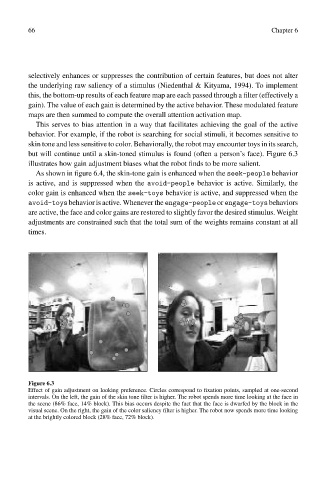
                       but will continue until a skin-toned stimulus is found (often a person’s face). Figure 6.3
                       illustrates how gain adjustment biases what the robot finds to be more salient.
                         As shown in figure 6.4, the skin-tone gain is enhanced when the seek-people behavior
                       is active, and is suppressed when the avoid-people behavior is active. Similarly, the
                       color gain is enhanced when the seek-toys behavior is active, and suppressed when the
                       avoid-toys behavior is active. Whenever the engage-people or engage-toys behaviors
                       are active, the face and color gains are restored to slightly favor the desired stimulus. Weight
                       adjustments are constrained such that the total sum of the weights remains constant at all
                       times.


                       Figure 6.3
                       Effect of gain adjustment on looking preference. Circles correspond to fixation points, sampled at one-second
                       intervals. On the left, the gain of the skin tone filter is higher. The robot spends more time looking at the face in
                       the scene (86% face, 14% block). This bias occurs despite the fact that the face is dwarfed by the block in the
                       visual scene. On the right, the gain of the color saliency filter is higher. The robot now spends more time looking
                       at the brightly colored block (28% face, 72% block).

