


Page 90 - Designing Sociable Robots
P. 90
breazeal-79017  book  March 18, 2002  14:2


                       The Vision System                                                     71


                         20
                         18
                         16
                         14
                        Pixel disparity  12 8
                         10


                          6
                          4
                          2
                          0
                           0   2   4   6   8   10  12   14  16
                                      Time (seconds)
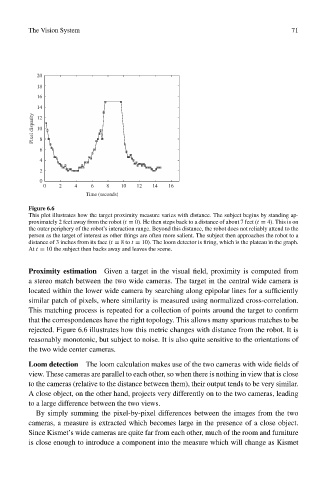
                       Figure 6.6
                       This plot illustrates how the target proximity measure varies with distance. The subject begins by standing ap-
                       proximately 2 feet away from the robot (t = 0). He then steps back to a distance of about 7 feet (t = 4). This is on
                       the outer periphery of the robot’s interaction range. Beyond this distance, the robot does not reliably attend to the
                       person as the target of interest as other things are often more salient. The subject then approaches the robot to a
                       distance of 3 inches from its face (t = 8to t = 10). The loom detector is firing, which is the plateau in the graph.
                       At t = 10 the subject then backs away and leaves the scene.


                       Proximity estimation  Given a target in the visual field, proximity is computed from
                       a stereo match between the two wide cameras. The target in the central wide camera is
                       located within the lower wide camera by searching along epipolar lines for a sufficiently
                       similar patch of pixels, where similarity is measured using normalized cross-correlation.
                       This matching process is repeated for a collection of points around the target to confirm
                       that the correspondences have the right topology. This allows many spurious matches to be
                       rejected. Figure 6.6 illustrates how this metric changes with distance from the robot. It is
                       reasonably monotonic, but subject to noise. It is also quite sensitive to the orientations of
                       the two wide center cameras.

                       Loom detection  The loom calculation makes use of the two cameras with wide fields of
                       view. These cameras are parallel to each other, so when there is nothing in view that is close
                       to the cameras (relative to the distance between them), their output tends to be very similar.
                       A close object, on the other hand, projects very differently on to the two cameras, leading
                       to a large difference between the two views.
                         By simply summing the pixel-by-pixel differences between the images from the two
                       cameras, a measure is extracted which becomes large in the presence of a close object.
                       Since Kismet’s wide cameras are quite far from each other, much of the room and furniture
                       is close enough to introduce a component into the measure which will change as Kismet

