


Page 94 - Designing Sociable Robots
P. 94
breazeal-79017  book  March 18, 2002  14:2


                       The Vision System                                                     75


                                Seek People                      Seek Toy
                         500                            500
                             face location                 face location
                           0                             0
                        Eye pan position  –1000  80% time spent  Eye pan position  –1000  83% time spent
                         –500
                                                       –500
                                      on face stimulus
                                                                    on toy stimulus
                        –1500  toy location           –1500  toy location
                        –2000                         –2000
                           0      50     100    150      0    50    100  150  200
                                  Time (seconds)                 Time (seconds)
                                 Avoid People                    Avoid Toy
                          500                           500
                             face location                   face location
                           0                              0
                        Eye pan position  –1000  5% time spent  Eye pan position  –1000  24% time spent
                                                        –500
                         –500
                                                                      on toy stimulus
                                       on face stimulus
                        –1500  toy location            –1500  toy location

                        –2000                          –2000
                            0     50    100   150         0    20  40  60   80  100
                                   Time (seconds)                 Time (seconds)
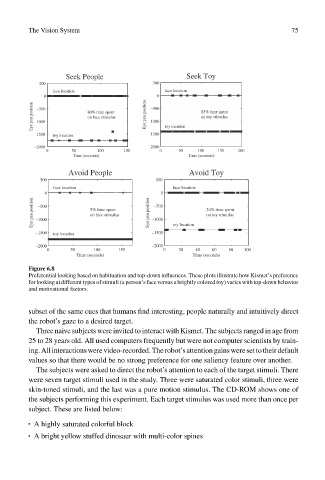
                       Figure 6.8
                       Preferential looking based on habituation and top-down influences. These plots illustrate how Kismet’s preference
                       for looking at different types of stimuli (a person’s face versus a brightly colored toy) varies with top-down behavior
                       and motivational factors.


                       subset of the same cues that humans find interesting, people naturally and intuitively direct
                       the robot’s gaze to a desired target.
                         Three naive subjects were invited to interact with Kismet. The subjects ranged in age from
                       25 to 28 years old. All used computers frequently but were not computer scientists by train-
                       ing.Allinteractionswerevideo-recorded.Therobot’sattentiongainsweresettotheirdefault
                       values so that there would be no strong preference for one saliency feature over another.
                         The subjects were asked to direct the robot’s attention to each of the target stimuli. There
                       were seven target stimuli used in the study. Three were saturated color stimuli, three were
                       skin-toned stimuli, and the last was a pure motion stimulus. The CD-ROM shows one of
                       the subjects performing this experiment. Each target stimulus was used more than once per
                       subject. These are listed below:

                       •  A highly saturated colorful block
                        A bright yellow stuffed dinosaur with multi-color spines
                       •

