


Page 89 - Designing Sociable Robots
P. 89
breazeal-79017  book  March 18, 2002  14:2


                       70                                                               Chapter 6


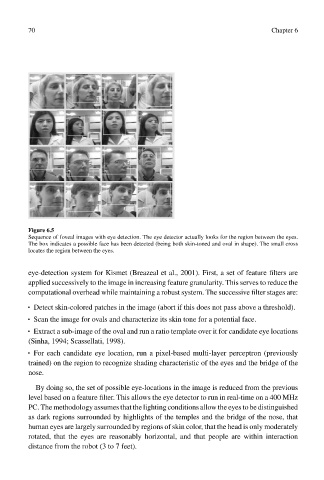
                       Figure 6.5
                       Sequence of foveal images with eye detection. The eye detector actually looks for the region between the eyes.
                       The box indicates a possible face has been detected (being both skin-toned and oval in shape). The small cross
                       locates the region between the eyes.


                       eye-detection system for Kismet (Breazeal et al., 2001). First, a set of feature filters are
                       applied successively to the image in increasing feature granularity. This serves to reduce the
                       computational overhead while maintaining a robust system. The successive filter stages are:

                       •  Detect skin-colored patches in the image (abort if this does not pass above a threshold).
                       •  Scan the image for ovals and characterize its skin tone for a potential face.
                       •  Extract a sub-image of the oval and run a ratio template over it for candidate eye locations
                       (Sinha, 1994; Scassellati, 1998).
                        For each candidate eye location, run a pixel-based multi-layer perceptron (previously
                       •
                       trained) on the region to recognize shading characteristic of the eyes and the bridge of the
                       nose.

                         By doing so, the set of possible eye-locations in the image is reduced from the previous
                       level based on a feature filter. This allows the eye detector to run in real-time on a 400 MHz
                       PC. The methodology assumes that the lighting conditions allow the eyes to be distinguished
                       as dark regions surrounded by highlights of the temples and the bridge of the nose, that
                       human eyes are largely surrounded by regions of skin color, that the head is only moderately
                       rotated, that the eyes are reasonably horizontal, and that people are within interaction
                       distance from the robot (3 to 7 feet).

