


Page 86 - Designing Sociable Robots
P. 86
breazeal-79017  book  March 18, 2002  14:2


                       The Vision System                                                     67


                                   Motivation
                                            Social    Stimulation
                                    System  Drive      Drive
                                   Behavior
                                   System   Satiate     Satiate
                         Perceptual         Social  Level 0  Stimulation
                        Categorization
                        “Person”  “Toy”
                        Percept  Percept  Satiation Strategies  Satiation Strategies
                                        Engage            Engage
                                        Person             Toy
                          Skin &  Color &        Level 1
                          Motion  Motion
                                    Avoid   Seek       Avoid   Seek
                                    Person  Person      Toy    Toy
                         Attention
                          System
                                  Suppress  Bias  Intensify  Suppress  Bias  Intensify
                                  skin gain  skin gain  skin gain  color gain  color gain  color gain
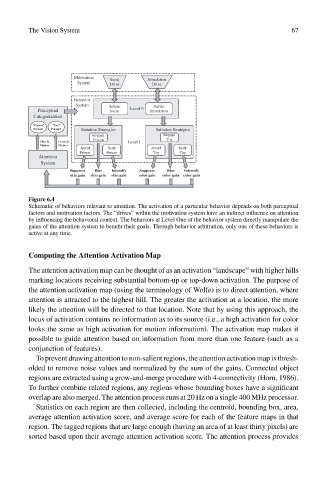
                       Figure 6.4
                       Schematic of behaviors relevant to attention. The activation of a particular behavior depends on both perceptual
                       factors and motivation factors. The “drives” within the motivation system have an indirect influence on attention
                       by influencing the behavioral context. The behaviors at Level One of the behavior system directly manipulate the
                       gains of the attention system to benefit their goals. Through behavior arbitration, only one of these behaviors is
                       active at any time.


                       Computing the Attention Activation Map
                       The attention activation map can be thought of as an activation “landscape” with higher hills
                       marking locations receiving substantial bottom-up or top-down activation. The purpose of
                       the attention activation map (using the terminology of Wolfe) is to direct attention, where
                       attention is attracted to the highest hill. The greater the activation at a location, the more
                       likely the attention will be directed to that location. Note that by using this approach, the
                       locus of activation contains no information as to its source (i.e., a high activation for color
                       looks the same as high activation for motion information). The activation map makes it
                       possible to guide attention based on information from more than one feature (such as a
                       conjunction of features).
                         To prevent drawing attention to non-salient regions, the attention activation map is thresh-
                       olded to remove noise values and normalized by the sum of the gains. Connected object
                       regions are extracted using a grow-and-merge procedure with 4-connectivity (Horn, 1986).
                       To further combine related regions, any regions whose bounding boxes have a significant
                       overlap are also merged. The attention process runs at 20 Hz on a single 400 MHz processor.
                         Statistics on each region are then collected, including the centroid, bounding box, area,
                       average attention activation score, and average score for each of the feature maps in that
                       region. The tagged regions that are large enough (having an area of at least thirty pixels) are
                       sorted based upon their average attention activation score. The attention process provides

