


Page 92 - Designing Sociable Robots
P. 92
breazeal-79017  book  March 18, 2002  14:2


                       The Vision System                                                     73


                                            Attention Gains
                          30
                         Deviation from default  –10 0
                          20
                          10

                                Face gain
                                Motion gain
                         –20
                                Color gain
                         –30
                            0        50       100       150       200
                                               Time (seconds)
                                        Interactions with a Person
                         2000
                         1000
                        Activation  0                         Social drive
                                                              Seek people
                        –1000                                 Engage people
                                                              Avoid people
                                                              Face percept
                        –2000
                            0        50       100       150       200
                                               Time (seconds)
                                         Interactions with a Toy
                         2000
                         1000
                        Activation  0  Stimulation drive
                                   Seek toy
                        –1000      Engage toy
                                   Avoid toy
                                   Color percept
                        –2000
                            0        50       100      150       200
                                              Time (seconds)
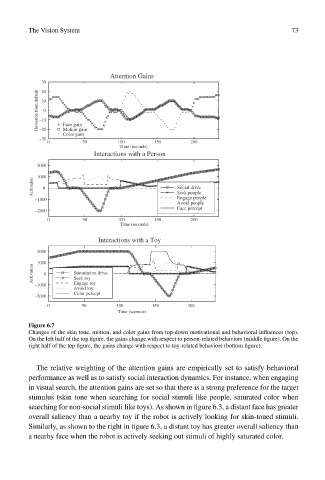
                       Figure 6.7
                       Changes of the skin tone, motion, and color gains from top-down motivational and behavioral influences (top).
                       On the left half of the top figure, the gains change with respect to person-related behaviors (middle figure). On the
                       right half of the top figure, the gains change with respect to toy-related behaviors (bottom figure).


                         The relative weighting of the attention gains are empirically set to satisfy behavioral
                       performance as well as to satisfy social interaction dynamics. For instance, when engaging
                       in visual search, the attention gains are set so that there is a strong preference for the target
                       stimulus (skin tone when searching for social stimuli like people, saturated color when
                       searching for non-social stimuli like toys). As shown in figure 6.3, a distant face has greater
                       overall saliency than a nearby toy if the robot is actively looking for skin-toned stimuli.
                       Similarly, as shown to the right in figure 6.3, a distant toy has greater overall saliency than
                       a nearby face when the robot is actively seeking out stimuli of highly saturated color.

