


Page 95 - Designing Sociable Robots
P. 95
breazeal-79017  book  March 18, 2002  14:2


                       76                                                               Chapter 6


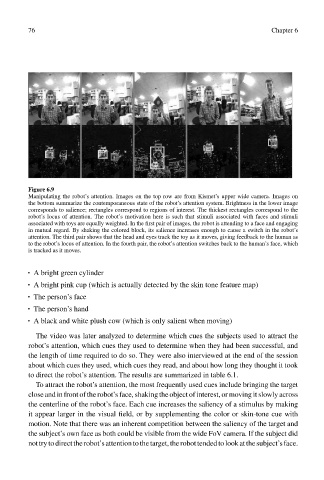
                       Figure 6.9
                       Manipulating the robot’s attention. Images on the top row are from Kismet’s upper wide camera. Images on
                       the bottom summarize the contemporaneous state of the robot’s attention system. Brightness in the lower image
                       corresponds to salience; rectangles correspond to regions of interest. The thickest rectangles correspond to the
                       robot’s locus of attention. The robot’s motivation here is such that stimuli associated with faces and stimuli
                       associated with toys are equally weighted. In the first pair of images, the robot is attending to a face and engaging
                       in mutual regard. By shaking the colored block, its salience increases enough to cause a switch in the robot’s
                       attention. The third pair shows that the head and eyes track the toy as it moves, giving feedback to the human as
                       to the robot’s locus of attention. In the fourth pair, the robot’s attention switches back to the human’s face, which
                       is tracked as it moves.


                       •  A bright green cylinder
                       •  A bright pink cup (which is actually detected by the skin tone feature map)
                       •  The person’s face
                       •  The person’s hand
                       •  A black and white plush cow (which is only salient when moving)
                         The video was later analyzed to determine which cues the subjects used to attract the
                       robot’s attention, which cues they used to determine when they had been successful, and
                       the length of time required to do so. They were also interviewed at the end of the session
                       about which cues they used, which cues they read, and about how long they thought it took
                       to direct the robot’s attention. The results are summarized in table 6.1.
                         To attract the robot’s attention, the most frequently used cues include bringing the target
                       close and in front of the robot’s face, shaking the object of interest, or moving it slowly across
                       the centerline of the robot’s face. Each cue increases the saliency of a stimulus by making
                       it appear larger in the visual field, or by supplementing the color or skin-tone cue with
                       motion. Note that there was an inherent competition between the saliency of the target and
                       the subject’s own face as both could be visible from the wide FoV camera. If the subject did
                       nottrytodirecttherobot’sattentiontothetarget,therobottendedtolookatthesubject’sface.

