


Page 96 - Designing Sociable Robots
P. 96
breazeal-79017  book  March 18, 2002  14:2


                       The Vision System                                                     77


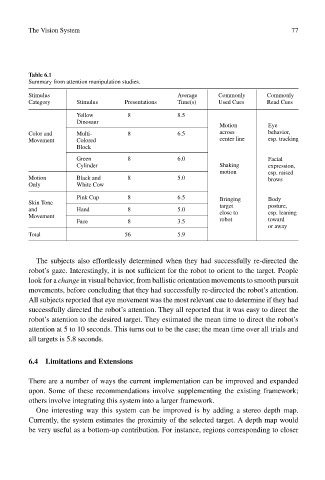
                       Table 6.1
                       Summary from attention manipulation studies.
                       Stimulus                               Average    Commonly     Commonly
                       Category    Stimulus     Presentations  Time(s)   Used Cues    Read Cues
                                   Yellow        8            8.5
                                   Dinosaur
                                                                         Motion       Eye
                       Color and   Multi-        8            6.5        across       behavior,
                       Movement    Colored                               center line  esp. tracking
                                   Block
                                   Green         8            6.0                     Facial
                                   Cylinder                              Shaking      expression,
                                                                         motion       esp. raised
                       Motion      Black and     8            5.0                     brows
                       Only        White Cow
                                   Pink Cup      8            6.5        Bringing     Body
                       Skin Tone
                       and         Hand          8            5.0        target       posture,
                       Movement                                          close to     esp. leaning
                                   Face          8            3.5        robot        toward
                                                                                      or away
                       Total                    56            5.9


                         The subjects also effortlessly determined when they had successfully re-directed the
                       robot’s gaze. Interestingly, it is not sufficient for the robot to orient to the target. People
                       look for a change in visual behavior, from ballistic orientation movements to smooth pursuit
                       movements, before concluding that they had successfully re-directed the robot’s attention.
                       All subjects reported that eye movement was the most relevant cue to determine if they had
                       successfully directed the robot’s attention. They all reported that it was easy to direct the
                       robot’s attention to the desired target. They estimated the mean time to direct the robot’s
                       attention at 5 to 10 seconds. This turns out to be the case; the mean time over all trials and
                       all targets is 5.8 seconds.

                       6.4 Limitations and Extensions


                       There are a number of ways the current implementation can be improved and expanded
                       upon. Some of these recommendations involve supplementing the existing framework;
                       others involve integrating this system into a larger framework.
                         One interesting way this system can be improved is by adding a stereo depth map.
                       Currently, the system estimates the proximity of the selected target. A depth map would
                       be very useful as a bottom-up contribution. For instance, regions corresponding to closer

