


Page 73 - Designing Sociable Robots
P. 73
breazeal-79017  book  March 18, 2002  14:1


                       54                                                               Chapter 5


                       The Vision System

                       The robot’s vision system consists of four color CCD cameras mounted on a stereo active
                       vision head. Two wide field of view (FoV) cameras are mounted centrally and move with
                       respect to the head. These are 0.25 inch CCD lipstick cameras with 2.2 mm lenses manu-
                       factured by Elmo Corporation. They are used to direct the robot’s attention toward people
                       or toys and to compute a distance estimate. There is also a camera mounted within the pupil
                       of each eye. These are 0.5 inch CCD foveal cameras with an 8 mm focal length lenses, and
                       are used for higher resolution post-attentional processing, such as eye detection.
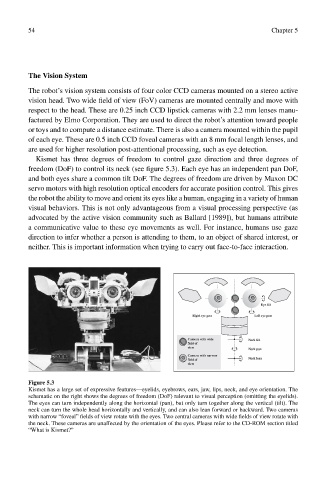
                         Kismet has three degrees of freedom to control gaze direction and three degrees of
                       freedom (DoF) to control its neck (see figure 5.3). Each eye has an independent pan DoF,
                       and both eyes share a common tilt DoF. The degrees of freedom are driven by Maxon DC
                       servo motors with high resolution optical encoders for accurate position control. This gives
                       the robot the ability to move and orient its eyes like a human, engaging in a variety of human
                       visual behaviors. This is not only advantageous from a visual processing perspective (as
                       advocated by the active vision community such as Ballard [1989]), but humans attribute
                       a communicative value to these eye movements as well. For instance, humans use gaze
                       direction to infer whether a person is attending to them, to an object of shared interest, or
                       neither. This is important information when trying to carry out face-to-face interaction.


                                                                                     Eye tilt
                                                                   Right eye pan   Left eye pan


                                                                 Camera with wide  Neck tilt
                                                                 field of
                                                                 view
                                                                                 Neck pan
                                                                 Camera with narrow
                                                                 field of        Neck lean
                                                                 view
                       Figure 5.3
                       Kismet has a large set of expressive features—eyelids, eyebrows, ears, jaw, lips, neck, and eye orientation. The
                       schematic on the right shows the degrees of freedom (DoF) relevant to visual perception (omitting the eyelids).
                       The eyes can turn independently along the horizontal (pan), but only turn together along the vertical (tilt). The
                       neck can turn the whole head horizontally and vertically, and can also lean forward or backward. Two cameras
                       with narrow “foveal” fields of view rotate with the eyes. Two central cameras with wide fields of view rotate with
                       the neck. These cameras are unaffected by the orientation of the eyes. Please refer to the CD-ROM section titled
                       “What is Kismet?”

