


Page 137 - Dynamic Loading and Design of Structures
P. 137
Page 113

               from log A the quantity log A0, where A0 is (arbitrarily) defined as the earthquake that would
               produce an amplitude of 0.001 mm on a standard seismograph at a distance of 100 km from
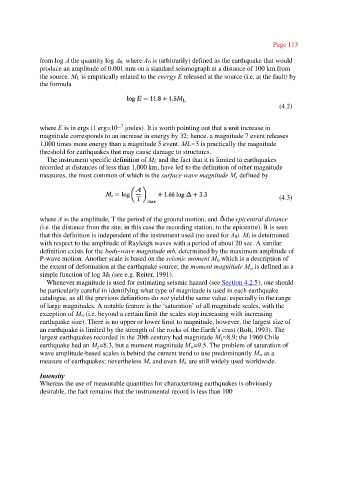
               the source. ML is empirically related to the energy E released at the source (i.e. at the fault) by
               the formula


                                                                                                   (4.2)


                                            7
               where E is in ergs (1 erg=10− joules). It is worth pointing out that a unit increase in
               magnitude corresponds to an increase in energy by 32; hence, a magnitude 7 event releases
               1,000 times more energy than a magnitude 5 event. ML=5 is practically the magnitude
               threshold for earthquakes that may cause damage to structures.
                 The instrument specific definition of ML and the fact that it is limited to earthquakes
               recorded at distances of less than 1,000 km, have led to the definition of other magnitude
               measures, the most common of which is the surface-wave magnitude M defined by
                                                                                    s

                                                                                                   (4.3)


               where A is the amplitude, T the period of the ground motion, and  the epicentral distance
               (i.e. the distance from the site, in this case the recording station, to the epicentre). It is seen
               that this definition is independent of the instrument used (no need for A0). Ms is determined
               with respect to the amplitude of Rayleigh waves with a period of about 20 sec. A similar
               definition exists for the body-wave magnitude mb, determined by the maximum amplitude of
               P-wave motion. Another scale is based on the seismic moment M which is a description of
                                                                             0
               the extent of deformation at the earthquake source; the moment magnitude M is defined as a
                                                                                         w
               simple function of log M0 (see e.g. Reiter, 1991).
                 Whenever magnitude is used for estimating seismic hazard (see Section 4.2.5), one should
               be particularly careful in identifying what type of magnitude is used in each earthquake
               catalogue, as all the previous definitions do not yield the same value, especially in the range
               of large magnitudes. A notable feature is the ‘saturation’ of all magnitude scales, with the
               exception of Mw (i.e. beyond a certain limit the scales stop increasing with increasing
               earthquake size). There is no upper or lower limit to magnitude, however, the largest size of
               an earthquake is limited by the strength of the rocks of the Earth’s crust (Bolt, 1993). The
               largest earthquakes recorded in the 20th century had magnitude M ≈8.9; the 1960 Chile
                                                                               L
               earthquake had an M =8.3, but a moment magnitude M =9.5. The problem of saturation of
                                   L
                                                                    w
               wave amplitude-based scales is behind the current trend to use predominantly Mw as a
               measure of earthquakes; nevertheless Ms and even ML are still widely used worldwide.

               Intensity
               Whereas the use of measurable quantities for characterizing earthquakes is obviously
               desirable, the fact remains that the instrumental record is less than 100

