


Page 139 - Dynamic Loading and Design of Structures
P. 139
Page 115

               outdoors’ (intensity VIII), while a typical diagnostic referring to buildings is ‘considerable
               damage in masonry structures built to withstand earthquakes’ (intensity IX).
                 Once intensities have been assigned to several areas (defined as explained earlier in this
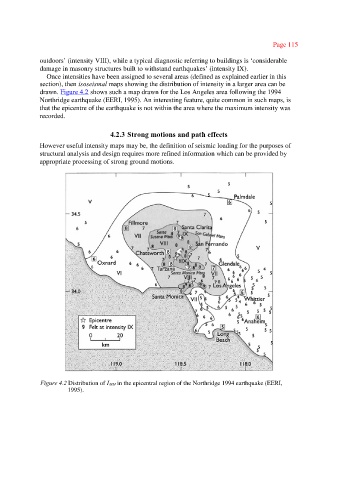
               section), then isoseismal maps showing the distribution of intensity in a larger area can be
               drawn. Figure 4.2 shows such a map drawn for the Los Angeles area following the 1994
               Northridge earthquake (EERI, 1995). An interesting feature, quite common in such maps, is
               that the epicentre of the earthquake is not within the area where the maximum intensity was
               recorded.


                                        4.2.3 Strong motions and path effects

               However useful intensity maps may be, the definition of seismic loading for the purposes of
               structural analysis and design requires more refined information which can be provided by
               appropriate processing of strong ground motions.


               Figure 4.2 Distribution of I MM in the epicentral region of the Northridge 1994 earthquake (EERI,
                         1995).

