


Page 144 - Dynamic Loading and Design of Structures
P. 144
Page 120

                 Directivity effects have been observed in several earthquakes, a recent example being that
               of the Northridge earthquake, where the only extensive region with accelerations above 0.5 g
               was to the north of the epicentre (see Figure 4.2), consistent with the rupture propagation
               (EERI, 1995). Of particular concern with regard to the seismic behaviour of structures is the
               case of large amplitude and long period pulses in the acceleration time history due to
               directivity effects; these pulses are usually accompanied by large velocities and can be quite
               catastrophic.


                                          4.2.4 Site and topography effects
               The ground motion can be significantly affected by the properties and configuration of the
               layers underlying the earth’s surface. The properties that most affect the amplitude of ground
               motion are the resistance to particle motion, called impedance., and the soil damping (or
                                                                                                   v
               absorption). For most practical purposes the impedance can be defined as the product ρ s
               where ρis the density and vs the previously defined (see eqn 4.1) shear wave velocity. The
                                                                                        2
                                                                                     v
               flow of energy (or energy flux) during the wave propagation is equal to ρ su ; hence, when a
               seismic wave propagates through a region of decreasing impedance, the resistance of soil
               particles to motion decreases, and to preserve the total energy, the particle velocity and hence
               the amplitude of motion increases. It follows that assuming all other conditions remain the
               same, the seismic waves would have higher amplitude on soil (low ρlow vs) than on rock
                                                                                 ,
                      ,
               (high ρhigh v ). On the other hand, damping is typically much higher on soft soils than on
                             s
               hard rock, therefore it tends to mitigate the adverse effect of low impedance in the former. As
               a result of the aforementioned effects, peak accelerations are generally not very different on
               sites classified as ‘rock’ and as ‘soil’ (or ‘alluvium’); usually peak accelerations at the surface
               of soil deposits are slightly higher than on rock outcrops when these accelerations are small
               (less than 0.15 g), and smaller at higher acceleration levels. Peak velocities, though, as well as
               displacements, are always higher on softer soil sites.
                 The configuration of the layers underlying a site, for example, whether they are essentially
               horizontal or not, and whether there are variations of their properties along the (horizontal)
               length, may also significantly affect the amplitude of ground motion. A detailed discussion of
               the complicated phenomena involved can be found elsewhere (Finn, 1991; Reiter, 1991;
               Kramer, 1996). Here it will only be pointed out that the most adverse effect of layer
               configuration is resonance, particularly two-dimensional one that can appear in alluvial
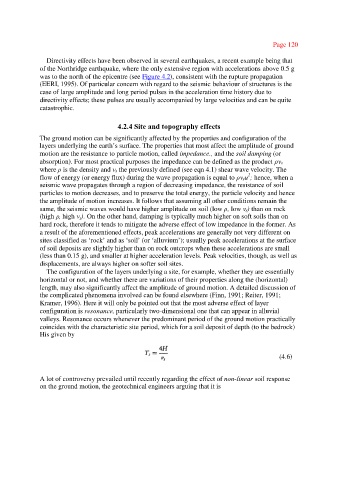
               valleys. Resonance occurs whenever the predominant period of the ground motion practically
               coincides with the characteristic site period, which for a soil deposit of depth (to the bedrock)
               His given by


                                                                                                   (4.6)


               A lot of controversy prevailed until recently regarding the effect of non-linear soil response
               on the ground motion, the geotechnical engineers arguing that it is

