


Page 145 - Dynamic Loading and Design of Structures
P. 145
Page 121

               significant and the seismologists maintaining that existing evidence does not support this view.
               The main implication of nonlinearity is that when a soil layer becomes strongly inelastic the
               shear stress cannot increase significantly, hence the amplitude of motion ceases to increase.
               This is obviously a desirable effect regarding the response of structures, but it causes
               problems regarding the reliability of data (on v and similar quantities) measured from
                                                            s
               microtremor or other small amplitude testing. Quantitative evidence from recent earthquakes
               such as the 1985 Michoacan (Mexico) and the 1989 Loma Prieta (California), has clearly
               shown that much higher accelerations can be recorded on sites underlain by soft soil layers
               (such as the Mexico City clay and the San Francisco Bay mud), than on stiffer soil sites.
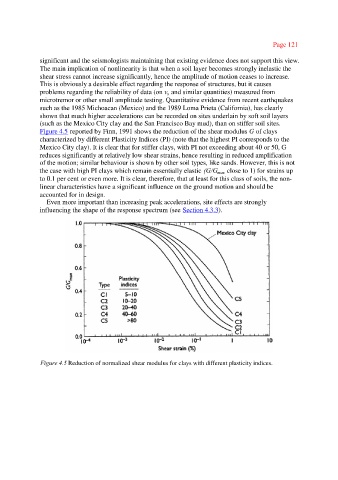
               Figure 4.5 reported by Finn, 1991 shows the reduction of the shear modulus G of clays
               characterized by different Plasticity Indices (PI) (note that the highest PI corresponds to the
               Mexico City clay). It is clear that for stiffer clays, with PI not exceeding about 40 or 50, G
               reduces significantly at relatively low shear strains, hence resulting in reduced amplification
               of the motion; similar behaviour is shown by other soil types, like sands. However, this is not
               the case with high PI clays which remain essentially elastic (G/G max  close to 1) for strains up
               to 0.1 per cent or even more. It is clear, therefore, that at least for this class of soils, the non-
               linear characteristics have a significant influence on the ground motion and should be
               accounted for in design.
                 Even more important than increasing peak accelerations, site effects are strongly
               influencing the shape of the response spectrum (see Section 4.3.3).


               Figure 4.5 Reduction of normalized shear modulus for clays with different plasticity indices.

