


Page 142 - Dynamic Loading and Design of Structures
P. 142
Page 118

               Attenuation relationships
               As the seismic waves propagate away from the source, their amplitude decreases; this results
               in the so-called attenuation of the ground motion. Attenuation is the reason why even the
               strongest motions cease to be damaging after a certain distance from the source. The previous
               statements should not be interpreted as meaning that the damage potential of a motion at, say,
               100 or 200 km from the source is always lower than at a distance of say 10 or 20 km. Site
               effects (Section 4.2.4) can lead to quite the opposite effect, a notable example being that of
               the 1985 earthquake off the coast of Mexico whose most catastrophic effects (including about
               10,000 fatalities) were recorded in Mexico City, 400 km away from the epicentre.
                 Attenuation relationships (i.e. models describing the values of strong motion parameters as
               a function of distance from the source) have been developed for magnitude, intensity
               (compare Figure 4.2), the strong motion peaks (PGA, PGV, PGD), and, more recently,
               spectral ordinates. The most commonly used one, particularly for defining seismic loads, is
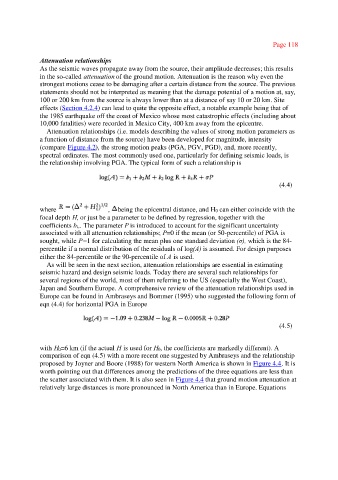
               the relationship involving PGA. The typical form of such a relationship is


                                                                                                   (4.4)


               where                   ,  being the epicentral distance, and H0 can either coincide with the
               focal depth H, or just be a parameter to be defined by regression, together with the
               coefficients bi,. The parameter P is introduced to account for the significant uncertainty
               associated with all attenuation relationships; P=0 if the mean (or 50-percentile) of PGA is
                                                                                      )
               sought, while P=1 for calculating the mean plus one standard deviation (σ, which is the 84-
               percentile if a normal distribution of the residuals of log(A) is assumed. For design purposes
               either the 84-percentile or the 90-percentile of A is used.
                 As will be seen in the next section, attenuation relationships are essential in estimating
               seismic hazard and design seismic loads. Today there are several such relationships for
               several regions of the world, most of them referring to the US (especially the West Coast),
               Japan and Southern Europe. A comprehensive review of the attenuation relationships used in
               Europe can be found in Ambraseys and Bommer (1995) who suggested the following form of
               eqn (4.4) for horizontal PGA in Europe


                                                                                                   (4.5)


               with H0=6 km (if the actual H is used for H0, the coefficients are markedly different). A
               comparison of eqn (4.5) with a more recent one suggested by Ambraseys and the relationship
               proposed by Joyner and Boore (1988) for western North America is shown in Figure 4.4. It is
               worth pointing out that differences among the predictions of the three equations are less than
               the scatter associated with them. It is also seen in Figure 4.4 that ground motion attenuation at
               relatively large distances is more pronounced in North America than in Europe. Equations

