


Page 143 - Dynamic Loading and Design of Structures
P. 143
Page 119


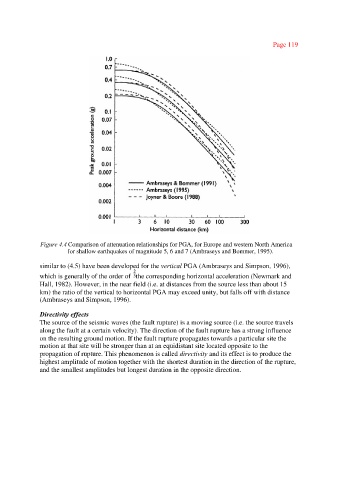
               Figure 4.4 Comparison of attenuation relationships for PGA, for Europe and western North America
                         for shallow earthquakes of magnitude 5, 6 and 7 (Ambraseys and Bommer, 1995).

               similar to (4.5) have been developed for the vertical PGA (Ambraseys and Simpson, 1996),

               which is generally of the order of the corresponding horizontal acceleration (Newmark and
               Hall, 1982). However, in the near field (i.e. at distances from the source less than about 15
               km) the ratio of the vertical to horizontal PGA may exceed unity, but falls off with distance
               (Ambraseys and Simpson, 1996).

               Directivity effects
               The source of the seismic waves (the fault rupture) is a moving source (i.e. the source travels
               along the fault at a certain velocity). The direction of the fault rupture has a strong influence
               on the resulting ground motion. If the fault rupture propagates towards a particular site the
               motion at that site will be stronger than at an equidistant site located opposite to the
               propagation of rupture. This phenomenon is called directivity and its effect is to produce the
               highest amplitude of motion together with the shortest duration in the direction of the rupture,
               and the smallest amplitudes but longest duration in the opposite direction.

