


Page 203 - Dynamic Loading and Design of Structures
P. 203
Page 178


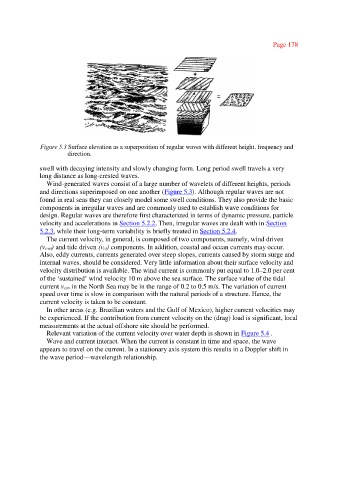
               Figure 5.3 Surface elevation as a superposition of regular waves with different height, frequency and
                         direction.

               swell with decaying intensity and slowly changing form. Long period swell travels a very
               long distance as long-crested waves.
                 Wind-generated waves consist of a large number of wavelets of different heights, periods
               and directions superimposed on one another (Figure 5.3). Although regular waves are not
               found in real seas they can closely model some swell conditions. They also provide the basic
               components in irregular waves and are commonly used to establish wave conditions for
               design. Regular waves are therefore first characterized in terms of dynamic pressure, particle
               velocity and accelerations in Section 5.2.2. Then, irregular waves are dealt with in Section
               5.2.3, while their long-term variability is briefly treated in Section 5.2.4.
                 The current velocity, in general, is composed of two components, namely, wind driven
               (v cwi) and tide driven (vct) components. In addition, coastal and ocean currents may occur.
               Also, eddy currents, currents generated over steep slopes, currents caused by storm surge and
               internal waves, should be considered. Very little information about their surface velocity and
               velocity distribution is available. The wind current is commonly put equal to 1.0–2.0 per cent
               of the ‘sustained’ wind velocity 10 m above the sea surface. The surface value of the tidal
               current v cto in the North Sea may be in the range of 0.2 to 0.5 m/s. The variation of current
               speed over time is slow in comparison with the natural periods of a structure. Hence, the
               current velocity is taken to be constant.
                 In other areas (e.g. Brazilian waters and the Gulf of Mexico), higher current velocities may
               be experienced. If the contribution from current velocity on the (drag) load is significant, local
               measurements at the actual offshore site should be performed.
                 Relevant variation of the current velocity over water depth is shown in Figure 5.4 .
                 Wave and current interact. When the current is constant in time and space, the wave
               appears to travel on the current. In a stationary axis system this results in a Doppler shift in
               the wave period—wavelength relationship.

