


Page 208 - Dynamic Loading and Design of Structures
P. 208
Page 181


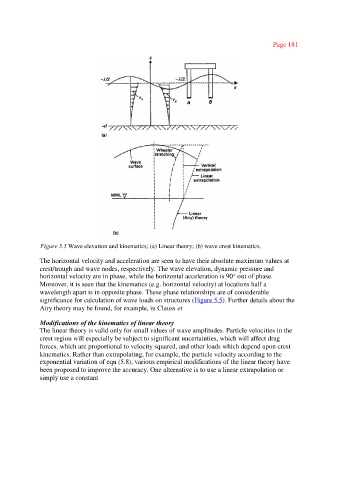
               Figure 5.5 Wave elevation and kinematics; (a) Linear theory; (b) wave crest kinematics.

               The horizontal velocity and acceleration are seen to have their absolute maximum values at
               crest/trough and wave nodes, respectively. The wave elevation, dynamic pressure and
               horizontal velocity are in phase, while the horizontal acceleration is 90° out of phase.
               Moreover, it is seen that the kinematics (e.g. horizontal velocity) at locations half a
               wavelength apart is in opposite phase. These phase relationships are of considerable
               significance for calculation of wave loads on structures (Figure 5.5). Further details about the
               Airy theory may be found, for example, in Clauss et

               Modifications of the kinematics of linear theory
               The linear theory is valid only for small values of wave amplitudes. Particle velocities in the
               crest region will especially be subject to significant uncertainties, which will affect drag
               forces, which are proportional to velocity squared, and other loads which depend upon crest
               kinematics. Rather than extrapolating, for example, the particle velocity according to the
               exponential variation of eqn (5.8), various empirical modifications of the linear theory have
               been proposed to improve the accuracy. One alternative is to use a linear extrapolation or
               simply use a constant

