


Page 211 - Dynamic Loading and Design of Structures
P. 211
Page 184

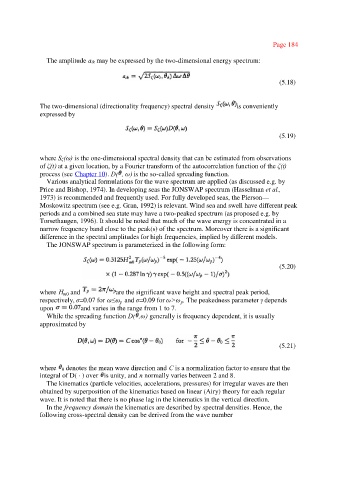
                 The amplitude aik may be expressed by the two-dimensional energy spectrum:


                                                                                                   (5.18)


               The two-dimensional (directionality frequency) spectral density      is conveniently
               expressed by


                                                                                                   (5.19)


                          )
               where Sζ (ω is the one-dimensional spectral density that can be estimated from observations
                   (
                                                                                                    (
               of ζt) at a given location, by a Fourier transform of the autocorrelation function of the ζt)
               process (see Chapter 10). D( , ω) is the so-called spreading function.
                 Various analytical formulations for the wave spectrum are applied (as discussed e.g. by
               Price and Bishop, 1974). In developing seas the JONSWAP spectrum (Hasselman et al.,
               1973) is recommended and frequently used. For fully developed seas, the Pierson—
               Moskowitz spectrum (see e.g. Gran, 1992) is relevant. Wind sea and swell have different peak
               periods and a combined sea state may have a two-peaked spectrum (as proposed e.g. by
               Torsethaugen, 1996). It should be noted that much of the wave energy is concentrated in a
               narrow frequency band close to the peak(s) of the spectrum. Moreover there is a significant
               difference in the spectral amplitudes for high frequencies, implied by different models.
                 The JONSWAP spectrum is parameterized in the following form:


                                                                                                   (5.20)


               where H m0  and            are the significant wave height and spectral peak period,
               respectively, σ=0.07 for ω≤ω and σ=0.09 for ω>ω. The peakedness parameter γdepends
                                                                 p
                                           p
               upon          and varies in the range from 1 to 7.
                 While the spreading function D( ,ω) generally is frequency dependent, it is usually
               approximated by


                                                                                                   (5.21)


               where   0 denotes the mean wave direction and C is a normalization factor to ensure that the
               integral of D( · ) over is unity, and n normally varies between 2 and 8.
                 The kinematics (particle velocities, accelerations, pressures) for irregular waves are then
               obtained by superposition of the kinematics based on linear (Airy) theory for each regular
               wave. It is noted that there is no phase lag in the kinematics in the vertical direction.
                 In the frequency domain the kinematics are described by spectral densities. Hence, the
               following cross-spectral density can be derived from the wave number

