


Page 214 - Dynamic Loading and Design of Structures
P. 214
Page 187

               in viscid and irrotational fluid is introduced and finally the convective term of acceleration is
               ignored, n denotes a normal to the surface, v is the particle velocity of the fluid and ρdenotes
               the density.
                 For a slender body, the water particle acceleration changes only slightly within the structure
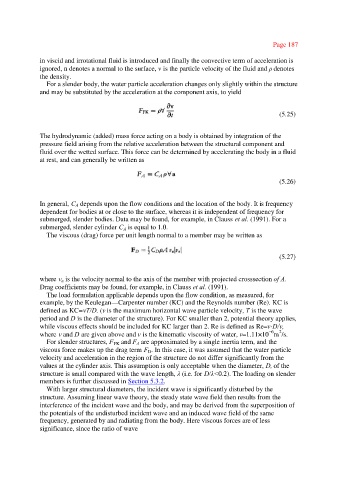
               and may be substituted by the acceleration at the component axis, to yield


                                                                                                   (5.25)


               The hydrodynamic (added) mass force acting on a body is obtained by integration of the
               pressure field arising from the relative acceleration between the structural component and
               fluid over the wetted surface. This force can be determined by accelerating the body in a fluid
               at rest, and can generally be written as


                                                                                                   (5.26)


               In general, CA depends upon the flow conditions and the location of the body. It is frequency
               dependent for bodies at or close to the surface, whereas it is independent of frequency for
               submerged, slender bodies. Data may be found, for example, in Clauss et al. (1991). For a
               submerged, slender cylinder C is equal to 1.0.
                                            A
                 The viscous (drag) force per unit length normal to a member may be written as


                                                                                                   (5.27)


               where v is the velocity normal to the axis of the member with projected crosssection of A.
                       n
               Drag coefficients may be found, for example, in Clauss et al. (1991).
                 The load formulation applicable depends upon the flow condition, as measured, for
               example, by the Keulegan—Carpenter number (KC) and the Reynolds number (Re). KC is
               defined as KC=vT/D. (v is the maximum horizontal wave particle velocity, T is the wave
               period and D is the diameter of the structure). For KC smaller than 2, potential theory applies,
               while viscous effects should be included for KC larger than 2. Re is defined as Re=v·D/v,
                                                                                                   2
                                                                                                −
                                                                                                6
               where v and D are given above and v is the kinematic viscosity of water, v=1.11×10 m /s.
                 For slender structures, F FK  and F are approximated by a single inertia term, and the
                                                 A
               viscous force makes up the drag term F . In this case, it was assumed that the water particle
                                                     D
               velocity and acceleration in the region of the structure do not differ significantly from the
               values at the cylinder axis. This assumption is only acceptable when the diameter, D, of the
                                                                 (
               structure is small compared with the wave length, λi.e. for D/λ<0.2). The loading on slender
               members is further discussed in Section 5.3.2.
                 With larger structural diameters, the incident wave is significantly disturbed by the
               structure. Assuming linear wave theory, the steady state wave field then results from the
               interference of the incident wave and the body, and may be derived from the superposition of
               the potentials of the undisturbed incident wave and an induced wave field of the same
               frequency, generated by and radiating from the body. Here viscous forces are of less
               significance, since the ratio of wave

