


Page 217 - Dynamic Loading and Design of Structures
P. 217
Page 190


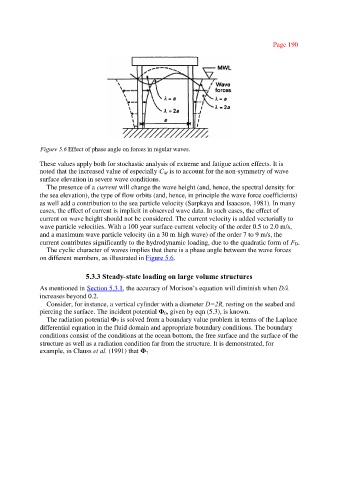
               Figure 5.6 Effect of phase angle on forces in regular waves.

               These values apply both for stochastic analysis of extreme and fatigue action effects. It is
               noted that the increased value of especially C is to account for the non-symmetry of wave
                                                           M
               surface elevation in severe wave conditions.
                 The presence of a current will change the wave height (and, hence, the spectral density for
               the sea elevation), the type of flow orbits (and, hence, in principle the wave force coefficients)
               as well add a contribution to the sea particle velocity (Sarpkaya and Isaacson, 1981). In many
               cases, the effect of current is implicit in observed wave data. In such cases, the effect of
               current on wave height should not be considered. The current velocity is added vectorially to
               wave particle velocities. With a 100 year surface current velocity of the order 0.5 to 2.0 m/s,
               and a maximum wave particle velocity (in a 30 m high wave) of the order 7 to 9 m/s, the
               current contributes significantly to the hydrodynamic loading, due to the quadratic form of FD.
                 The cyclic character of waves implies that there is a phase angle between the wave forces
               on different members, as illustrated in Figure 5.6.


                               5.3.3 Steady-state loading on large volume structures
               As mentioned in Section 5.3.1, the accuracy of Morison’s equation will diminish when D/λ
               increases beyond 0.2.
                 Consider, for instance, a vertical cylinder with a diameter D=2R, resting on the seabed and
               piercing the surface. The incident potential Φ , given by eqn (5.3), is known.
                                                           0
                 The radiation potential Φ is solved from a boundary value problem in terms of the Laplace
                                          7
               differential equation in the fluid domain and appropriate boundary conditions. The boundary
               conditions consist of the conditions at the ocean bottom, the free surface and the surface of the
               structure as well as a radiation condition far from the structure. It is demonstrated, for
               example, in Clauss et al. (1991) that Φ 7

