


Page 220 - Dynamic Loading and Design of Structures
P. 220
Page 193

               floating structures and structural dynamics of bottom supported structures. In the latter case
               the relative velocity term in eqn (5.31) should be used with caution. The amplitude of the
               structures motion needs to be equal to the member diameter to set up the fluid flow for which
               eqn (5.31) is valid. Otherwise, using eqn (5.31) may overestimate the damping and hence lead
               to non-conservative load effects.
                 Analogous considerations apply to large volume structures (large cross-section dimension
               relative to the wavelength). However, in that case the FK and added mass loads both need to
               be determined by analytical or numerical methods, as mentioned in Section 5.3.3. The added
               mass and damping contributions are then determined by introducing a potential Φ for each of
                                                                                              j
               the six rigid body modes as well as possible flexible modes.
                 For the structures considered herein wave kinematics is commonly determined with
               reference to the initial position of the structure. When motion amplitudes become large (i.e. of
               the order of the wave amplitude), the position of the structure may be updated, when
               excitation forces are determined.


                                            5.3.5 Non-linear wave loading

               Slender bodies
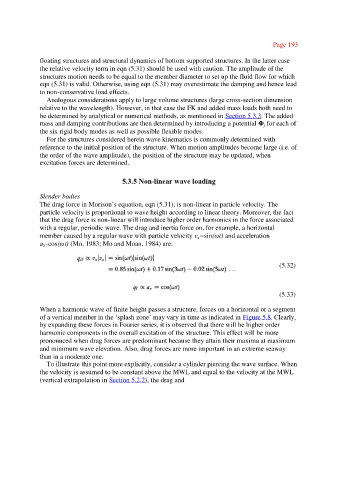
               The drag force in Morison’s equation, eqn (5.31), is non-linear in particle velocity. The
               particle velocity is proportional to wave height according to linear theory. Moreover, the fact
               that the drag force is non-linear will introduce higher order harmonics in the force associated
               with a regular, periodic wave. The drag and inertia force on, for example, a horizontal
               member caused by a regular wave with particle velocity v =sin(ω) and acceleration
                                                                              t
                                                                      x
               ax=cos(ωt) (Mo, 1983; Mo and Moan, 1984) are:

                                                                                                   (5.32)


                                                                                                   (5.33)

               When a harmonic wave of finite height passes a structure, forces on a horizontal or a segment
               of a vertical member in the ‘splash zone’ may vary in time as indicated in Figure 5.8. Clearly,
               by expanding these forces in Fourier series, it is observed that there will be higher order
               harmonic components in the overall excitation of the structure. This effect will be more
               pronounced when drag forces are predominant because they attain their maxima at maximum
               and minimum wave elevation. Also, drag forces are more important in an extreme seaway
               than in a moderate one.
                 To illustrate this point more explicitly, consider a cylinder piercing the wave surface. When
               the velocity is assumed to be constant above the MWL and equal to the velocity at the MWL
               (vertical extrapolation in Section 5.2.2), the drag and

